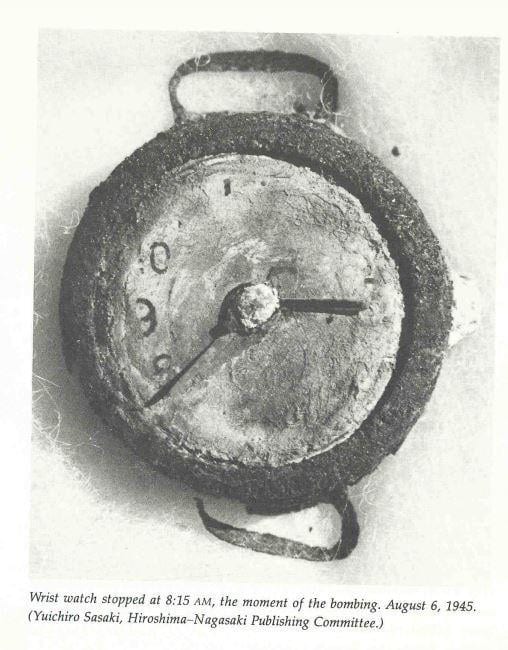
"Hiroshima clock. A charred clock, stopped at 8.15 in the morning, the moment when the atomic bomb devastated Hiroshima, Japan, on 6 August 1945. Dropped by the US Air Force, the 'Little Boy' uranium bomb [..] exploded 580 metres above the city of Hiroshima with a force of 12,500 tons of TNT. It killed 140,000 people by the end of 1945, and a further 60,000 from wounds or radiation" - Science Photo Library
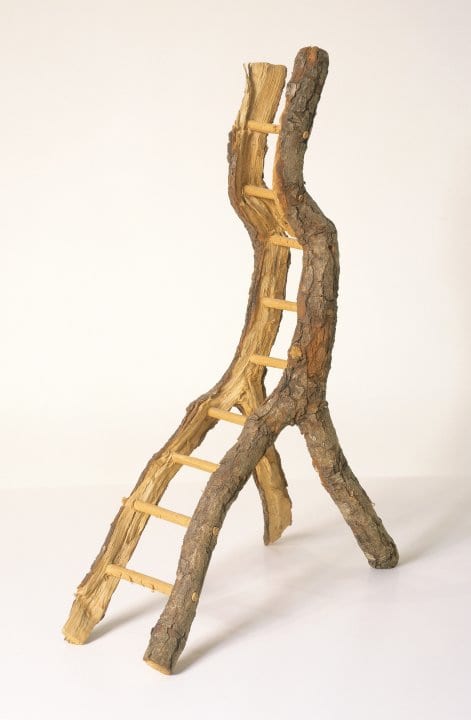
David Nash, Small Ladder, 1978, wood. Nash's unseasoned timber allows, according to Ingold, ‘the wood to live on beyond the life of the tree of which it was once a growing trunk or limb, without ever losing touch with its arboreal roots. Observing one of Nash’s ladders, for example, the wood appears to body forth from the thing made from it, rather than retreating back-stage as is the case with its factory-made equivalent in the showroom. [.. W]ith the passage of time the wood – as it seasons – splits, warps and cracks, eventually settling into a shape quite different from that given to it by the sculptor’s initial intervention.’ - Materials against materiality Tim Ingold 2007 Cambridge University Press
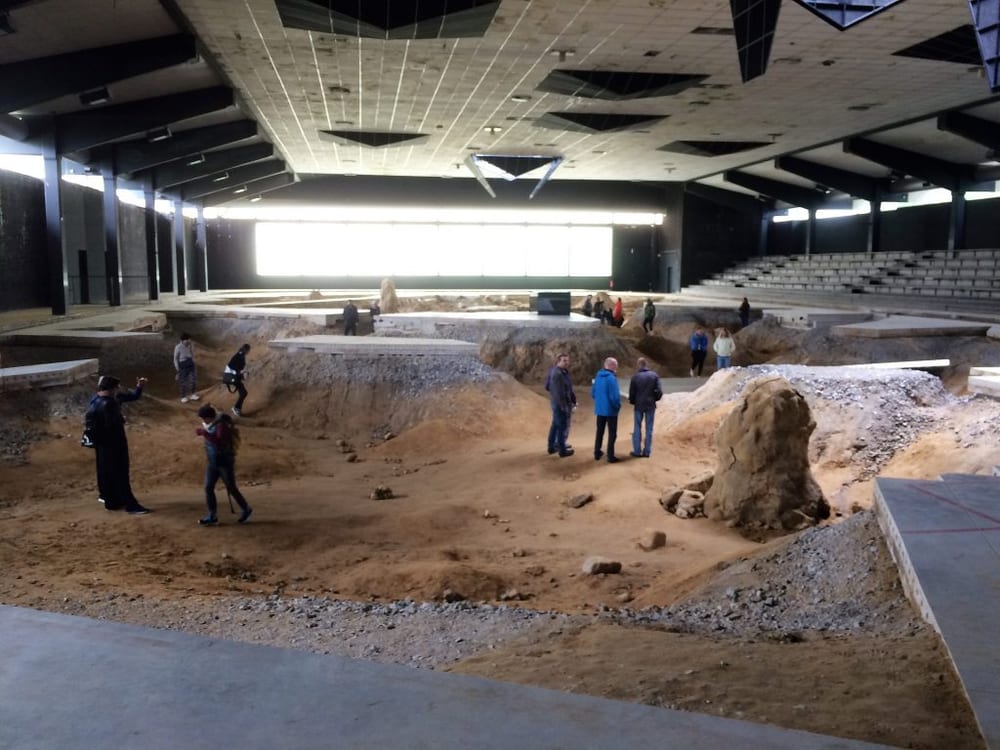
Artwork | Pierre Huyghe, After ALife Ahead for Münster’s Skulptur Projekte (2017). A time-based bio-technical system in a former ice rink that closed in 2016. This installation asked, what does a material want? It questioned where human intervention ended and material autonomy began. The materials continued to visibly interact when no audience was participating. It was ‘an artwork that is slowly spiralling into something else, moving away from its creator, and only giving off little glimpses of its operations as it evolves. Through October 1, when Skulptur Projekte closes, rain will keep flowing in, the algae will still grow, and the landscape will continue to change.' Throughout the installation: 'An incubator holds cancer cells whose rate of growth is determined by various measurements that sensors are taking of the space, which is also home to chimera peacocks and bees (though I have to admit that I saw neither during my visit). As the cancer cells change, they guide the behavior of black shapes that appear in an augmented reality app that visitors can download onto their phones. “What you have there is really a network of self-organizing systems,” Huyghe said. “They are in constant displacement. They grow, they evolve, they shift"' The quotes above were taken from a review by Andrew Russeth for Art News titled Constant Displacement: Pierre Huyghe on His Work at Skulptur Projekte Münster (still available online).
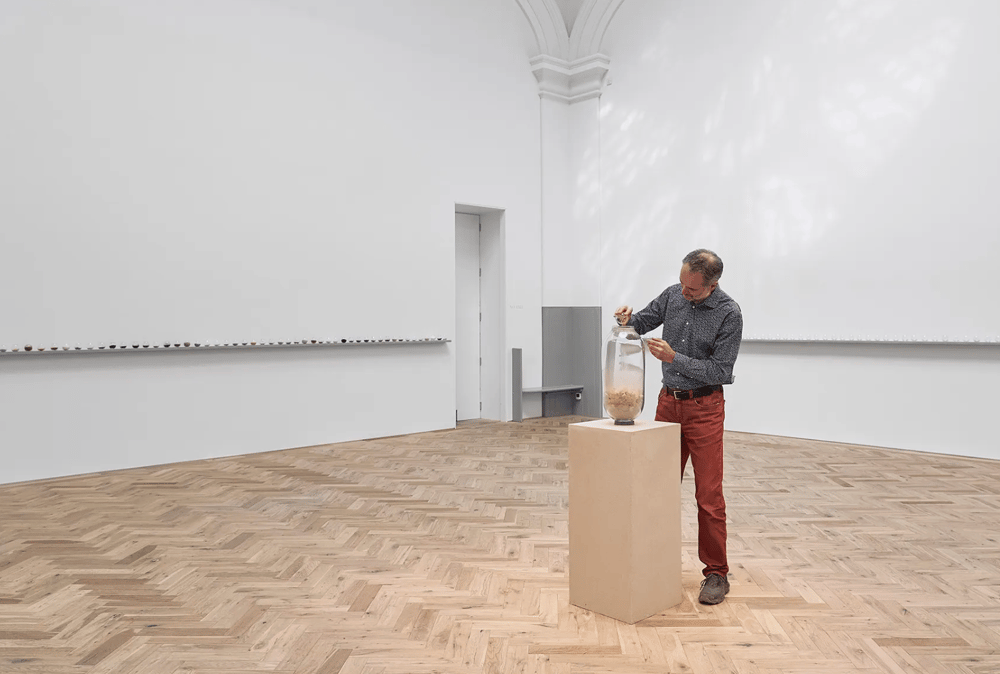
Artwork | Kate Paterson, Requiem, 2022
'Requiem tells of the birth and life of our planet in a single object – an object that uses dust gathered from material dating from pre-solar times to those of the present.
A large glass urn, the ancient form of funerary vessel, sits at the centre of the gallery. Around the walls a long shelf holds a series of small glass vials, 364 of them in all, each containing a tablespoon of dust. Each is a layer of time waiting to be poured into the urn by members of the public, and by invited guests. The dust has been obtained through collaboration with institutions and collections worldwide, and collectively, the vials map the story of the Earth from before its existence to the present day, and offer a lament for the planet, a warning, a requiem on the theme of extinction. The pouring will begin with a layer pre-solar dust from the oldest of meteorites, stretching back across the furthest distances of time and place, then the asteroid Vesta, a reminder of our planet’s origin still visible as the brightest asteroid in the night sky. There follows a slow unfurling of planetary history, from the oldest earthly rock formation of the 4.5-billion-year-old Pre-Cambrian era to the first creatures to open their eyes, the first flowers to flower, the first skeletal structures and the slow emergence of humanity’s antecedents from ocean to land. There are the crushed-to-dust remnants of our most archaic ancestors, from the earliest hunter-gatherers of Doggerland, through cultures and epochs long gone – Phoenician, Bactrian, Inca, Hellenistic, Roman, Pre-Columbian, Viking – each pouring of dust taking us layer by layer through the origins of everything, and the extinction of so much that is left in our wake.'
Requiem was commissioned by the National Glass Centre, Sunderland Culture, and Ingleby Gallery.
image: [https://katiepaterson.org/artwork/requiem/](https://katiepaterson.org/artwork/requiem/)
Every asphalt roadway and concrete structure contains fragments, often still readable, from the chronicles of prior geologic regimes, irreverently blended and reconstituted. The metals in our cars, phones, and computers, having been separated from their source rocks, are more akin to individual letters in a shredded manuscript, but still whisper of their deep geologic origins. All the coal, oil, and natural gas we’ve burned—the photosynthetic memories of earlier ecosystems—hovers now in the air, the ghosts of combustion that haunt us in the Anthropocene.
— Wrinkled Time The Persistence of Past Worlds on Earth by Marcia Bjornerud, Emergence Magazine