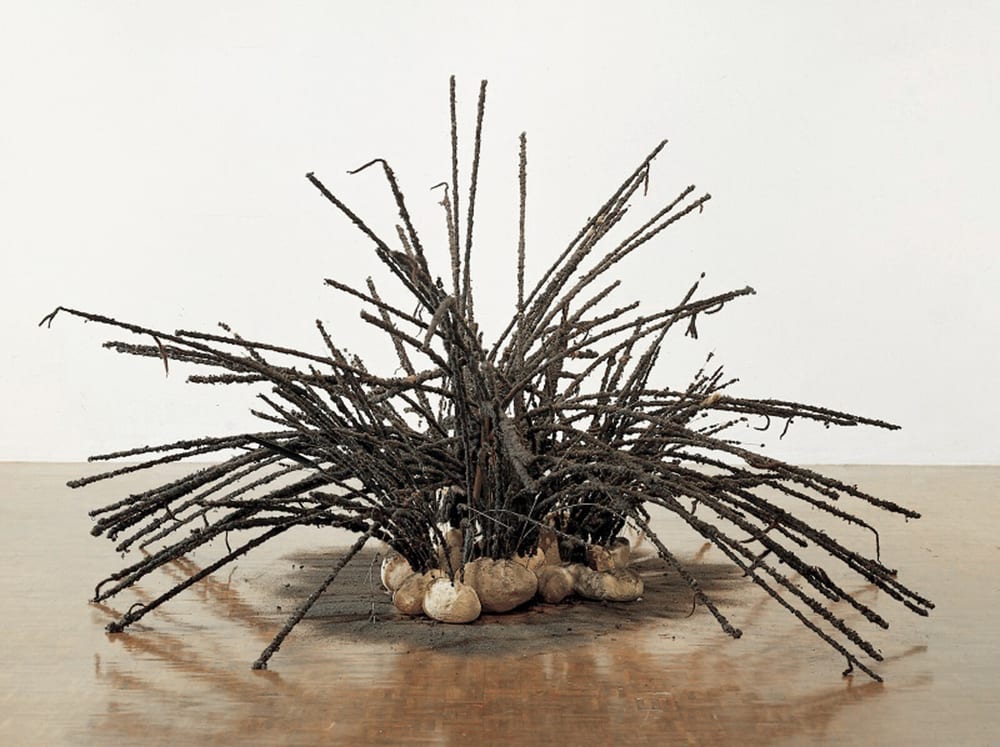
David Hammons, Untitled, 1992. Human hair gathered from the floor of barbershops, stones and metal wire
David Hammons, Untitled, 1992. Human hair gathered from the floor of barbershops, stones and metal wire
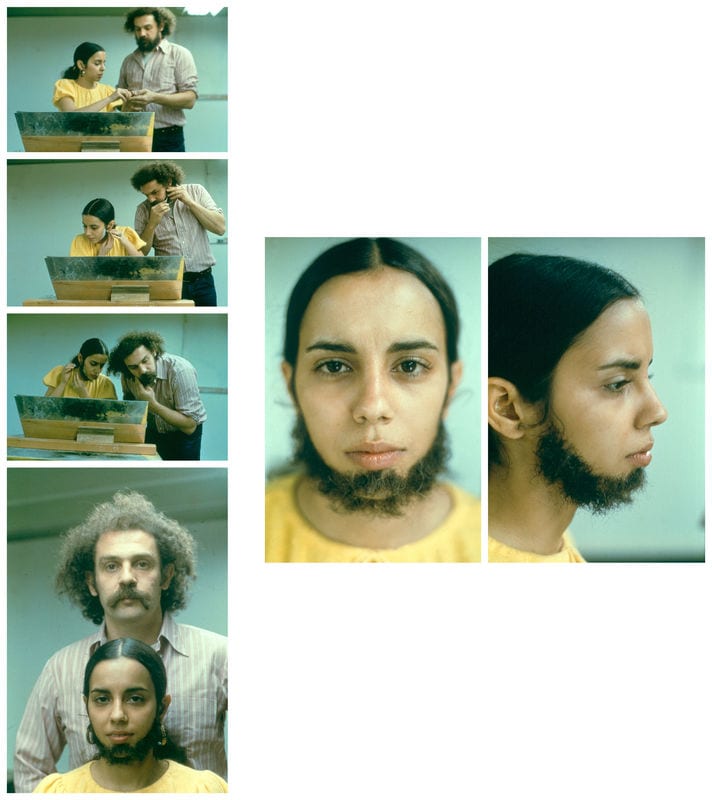
Ana Mendieta, Artist, Untitled (Facial Hair Transplants) , 1972, seven estate color photographs where Mendieta glued her friend's beard onto her face. Highlighting 'the fact that sexual classifications are social conventions that frame and overdetermine sexualities. By staging a mutant sexual identification, the artist problematized those classifications and disrupted the normative models of beauty by which society operates, differentiating between the feminine and the masculine.' - Hammer Museum
We wash, brush, style, cut, straighten and condition the hair on our head to give it ‘life’, irrespective of its innate death. While considered seductive on the head, hair evokes disgust when its death is revealed, viewed as detritus, separated from the body - on clothing, in the plug hole, in food.
— Kathryn Lloyd, Women and hair: materialising the Abject Wright, Karen, Turner Contemporary (Arts organization : Margate, England), (2017) Entangled : threads & making Turner Contemporary
In his essay Materials Against Materiality, Tim Ingold describes how several materials which come from animal bodies are used in traditional tent-making practices around the world. The materials include wool, bone and feathers, he also references “Skins: these usually have to be softened by being scraped and beaten – a long and arduous task. Then they have to be cured by soaking in substances such as sour milk, camel dung or bark fermented in urine.” As well as “Hair: North African pastoralists make ‘black tents’ from goat hair which is spun on a drop spindle and woven on a ground-loom. Hair is also used to fill mattresses and to make rope, and is suitable for warp threads in weaving rugs and blankets. In addition, it is used for making paint brushes.” - T.Ingold (2007) Materials Against Materiality, Cambridge University Press
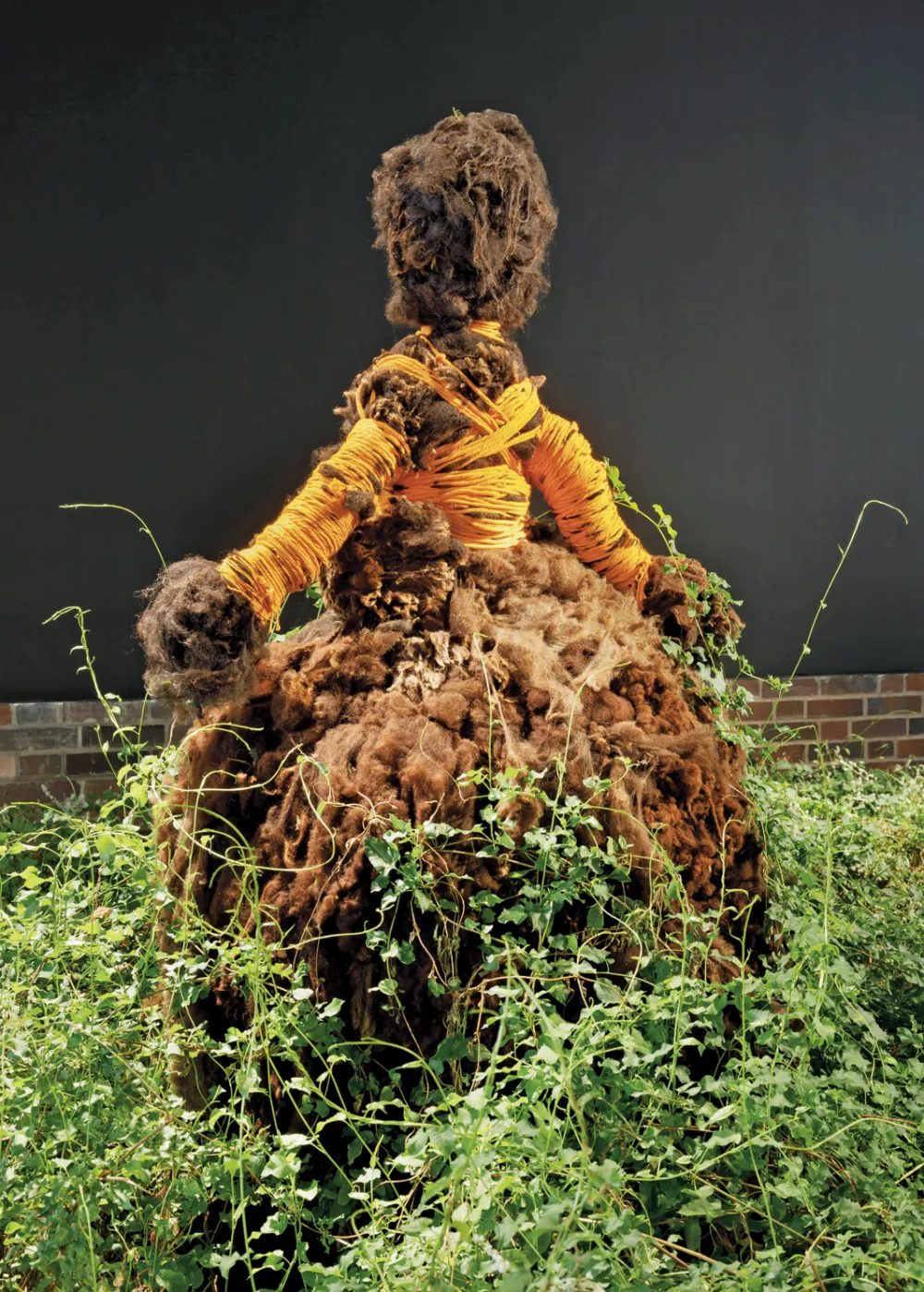
Precious Okoyomon, Angel of death, 2020, raw lambswool, dirt, wire, yarn. Earthseed, Zollamt MMK, Frankfurt. The sculpture is surrounded by Kudzu plants imported from Amsterdam. "In 1876, the United States government introduced the Japanese vine kudzu to Mississippi. The state was in danger of being lost entirely to widespread soil erosion brought about by the extensive cultivation of cotton by chattel slaves, and the vine—already notorious for the speed at which it grew—was deployed as a weapon intended to fortify the ground soil. Instead, kudzu—now thousands of miles away from its home in Japan—became monstrous, consuming everything in its vicinity and earning the epithet “the vine that ate the south.” The word kudzu has meanwhile become a metonymy for the threat of invasive species everywhere." - from the press release.
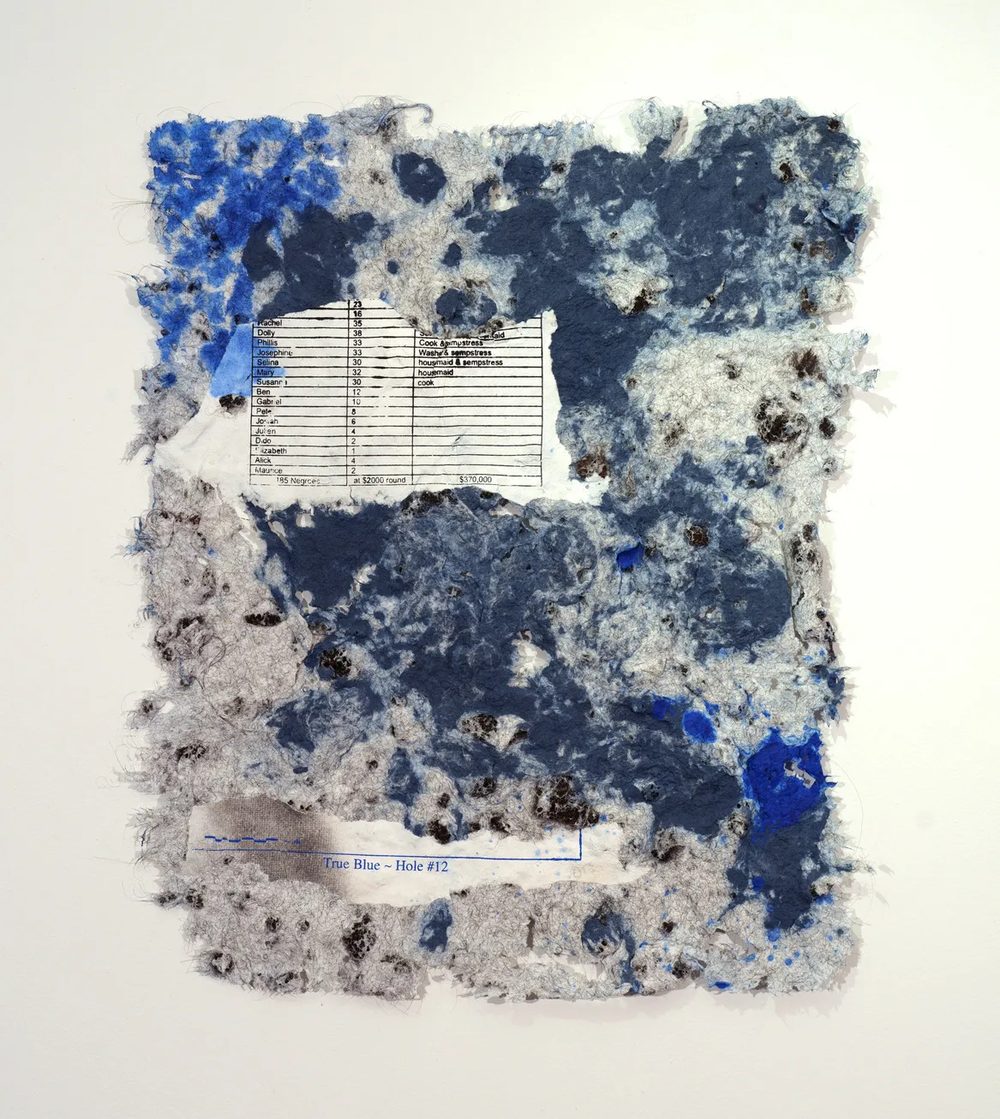
Artist | Adebunmi Gbadebo (b. 1992 in Livingston, New Jersey) is a multimedia artist. Human Hair features as a material across her sculptural and two dimensional works. Her website states, about the paper works: "When creating paperworks, she invokes the Japanese couching technique, preparing a vat of pulp made from donated hair and raw cotton, pulverizing the natural fibers in collected water from rivers at True Blue, pouring the pulp onto a screen, and hand treating the fiber—molding it into organic forms, dyeing it with indigo, and silkscreening fragments from True Blue’s plantation archives, her family’s nineteenth and twentieth century photographs, and other primary sources."