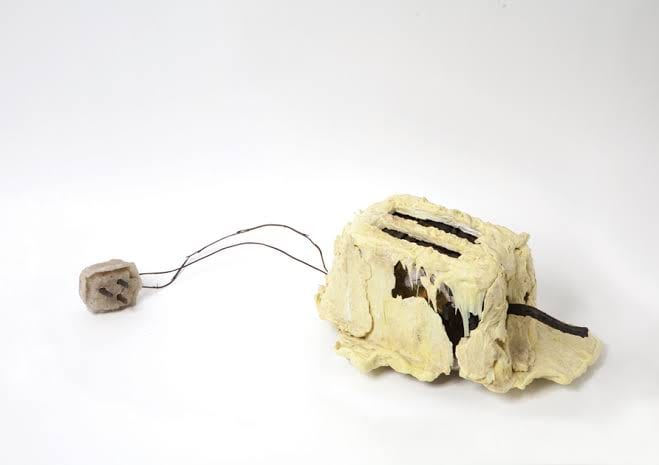
In his book The Toaster Project, Thomas Thwaites sets out to make a toaster from scratch - souring the raw materials from the earth, creating iron, mining quartz & making plastic. He starts by taking apart a £3.94 Argos toaster (the model which he will base his toaster on). This process of reverse engineering reveals that the toaster contains hundreds of parts. Seperating these parts into materials is complex when you factor in the various assemblages, chemically different types of plastic and various inclusions of dyes mixed in with other materials. I love this project becasue it perfectly illustrates the idea that we know where nothing comes from, and we pay staggeringly little for the materials and extractive processes that we are consuming. These technologies have become so cheap that the price implies they are disposable, yet, as we learn on p.154 “the cheap toasters I’ve taken apart have been hand soldered”. It isnt just the extensive material parts, the journey all of these materials have travelled to become part of the toaster, its also the invisible and underpaid labour that is being undervalued. The book highlights how “The point at which it stopped being possible for us to make the things that surround us is long past.” When he is journeying to extract iron ore, copper and mica, we are reminded of how we’re so used to thinking of materials sharply distinct from one other, but it's easy to forget that in the messiness of the real world, pretty much everything is mixed together. This 'heroic attempt' is an impossible yet satisfying task. And amazingly the book is Open Source on Thwaites' website.
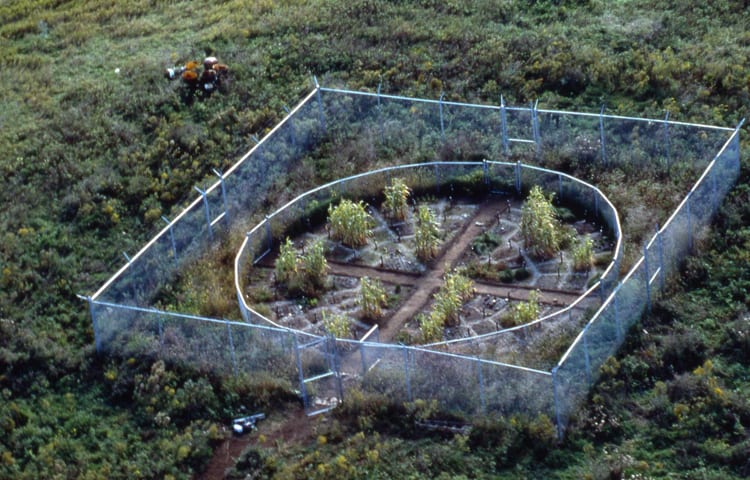
Mel Chin, 1991-ongoing, plants, industrial fencing on a hazardous waste landfill. An ongoing project in conjunction with Dr. Rufus Chaney, senior research agronomist, USDA. "field test using special hyperaccumulator plants to extract heavy metals from contaminated soil. Scientific analysis of biomass samples from this field confirmed the potential of “Green Remediation” as an on-site, low-tech alternative to current costly and unsatisfactory remediation methods. Despite soil conditions adverse to metal uptake, a variety of Thlaspi, the test plant with the highest capacity for hyperaccumulation, was found to have significant concentration of cadmium in its leaves and stems." - Mel Chin website
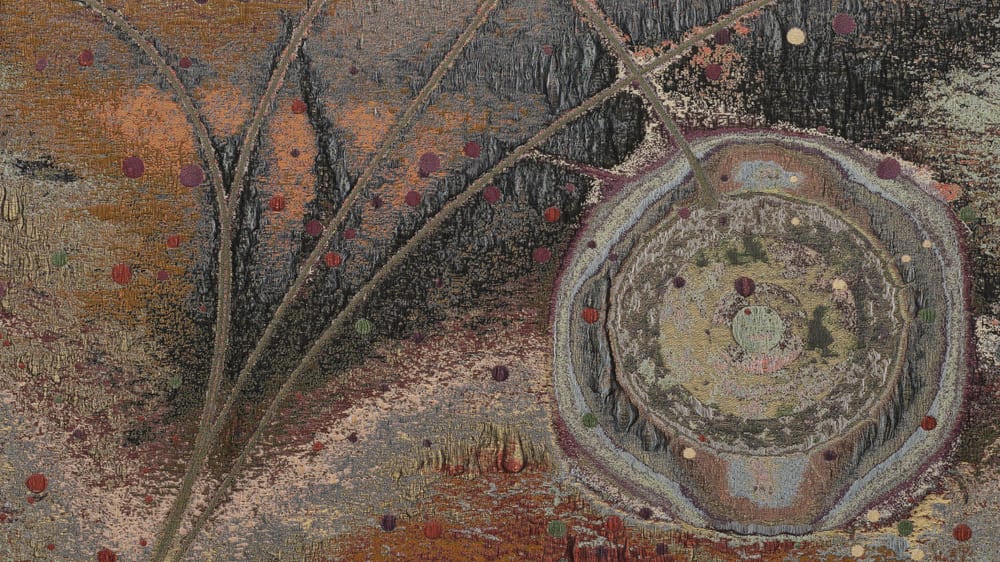
Sunburst, Otobong Nkanga, 2024, woven textile, 130 x 356 x 2 cm, Lisson Gallery. " a God’s-eye view of a circular form, part heat-hazed sun, part pulsing, unstable atom, hovering above a parched and inhospitable landscape." - ArtReview
And now I want to turn my attention to an actual prison mine to talk about these intrasubjective modes of material experience. […] Building on the structures of property under slavery, convict lease labour extended the long arm of extraction over black subjectivity […]. Yet while steel and iron came onto the track shiny, bodies of the incarcerated routinely disappeared into the heaps of cast off matter at the shaft entrance. […] Minerality worked in the underground is transformed into flows of social power on the surface, continuing the enduring structural relation of subterranean racial ordering. The micro-spacialities of race in urban space were vertical, as the mines went down, the skyscrapers of the heaviest corner on earth went up between 20th street and 1st avenue north in The Magic City
— Kathryn Yusoff’s lecture Geo-Logics: Natural Resources and Necropolitics. Available on Youtube
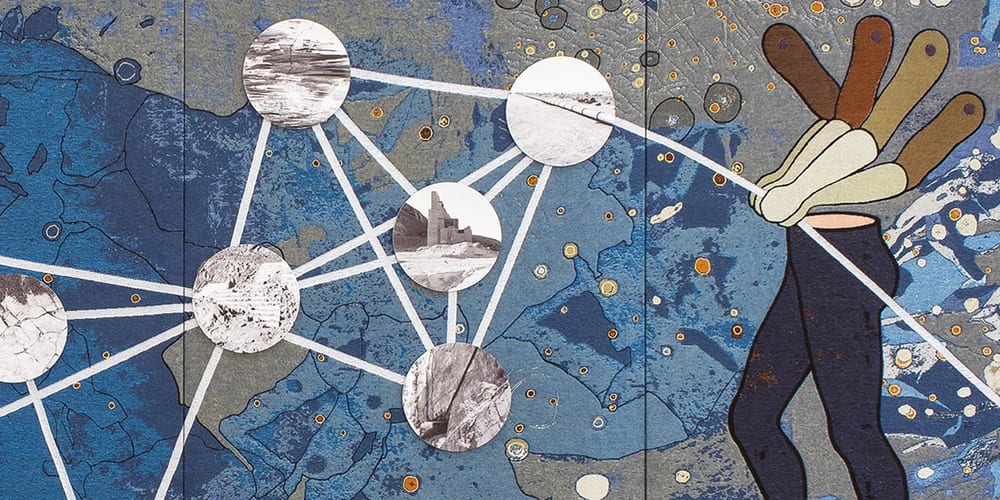
Artwork | Otobong Nkanga, The Weight of Scars detail (2015), woven textile (yarns: viscose, wool, polyester, mohair, acryl, and cotton), inkjet prints on ten lasercut forex plates, four parts, 251.5 × 612.1 cm.
Speaking on 'A Brush With', Nkanga described how she is interested in the histrories of Flemish, African, South East Asian, Japanese tapestries to name a few, and the yarns, colours and patterns from each place. How her tapestries are about an "understanding of material, and how those materials really relate to what the land can offer. So if we’re thinking of Indigo and we’re looking at the African tapestries and African fabrics you’re seeing actually the history of the land within the tapestry. If we look at the Flemish tapestry, we can see the discovery of greens. You can see periods in which the chemistry and the technology becomes apparent. [..] certain colours that were not there before start becoming part of the fabric"
About this work: A combinitation of textiles and photographs in which two 'fragmented figures are connected to a network of ropes and pipelines that converge at photographs of abandoned mines. Their arms are shown in multiple positions suggesting the ‘push and pull’ of shifting relationships as land is consumed and changed. The ‘scars’ in the title suggest damaged and vulnerable bodies within a landscape devastated by the extraction of knowledge, people and resources.' - tate.org.uk
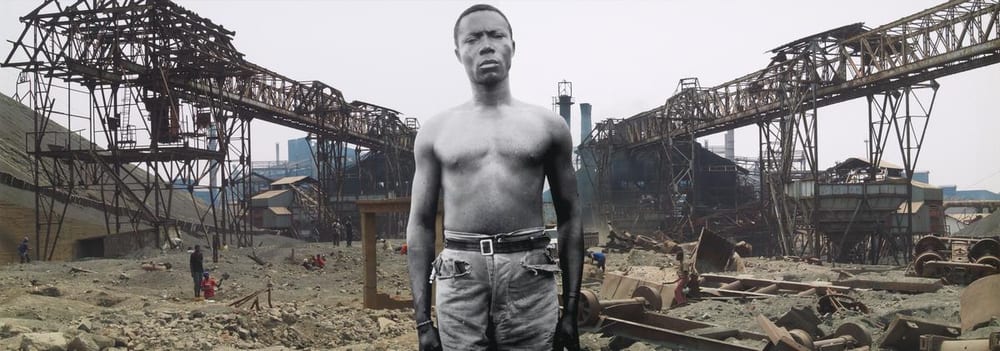
Sammy Baloji
Untitled 17, 2006, Photograph, inkjet print on paper, mounted on aluminium, printed 2020, Sammy Baloji. "Each work in the series is a digital photomontage in which archival images of Congolese labourers from the colonial period have been superimposed onto photographs taken by Baloji of the mineral mines located around Lubumbashi in the Democratic Republic of Congo, which are now in a state of decline and ruin" - Tate website. "Wood, rubber, ivory, diamonds, gold, cobalt, tin, copper, coffee, petroleum, gas, uranium, radium, tantalum: the Democratic Republic of Congo is a trove of natural resources. This has been used to justify a century and a half of brutal subjugation, from Leopold II of Belgium’s personal fiefdom to war-torn republic, exploited and extracted from by neighbouring and distant powers. The art of Sammy Baloji (b1978), who hails from the DRC’s southern Katanga province, explores the history and memory of his country, from the colonial era to present-day economic imperialism." - Studio International
Every asphalt roadway and concrete structure contains fragments, often still readable, from the chronicles of prior geologic regimes, irreverently blended and reconstituted. The metals in our cars, phones, and computers, having been separated from their source rocks, are more akin to individual letters in a shredded manuscript, but still whisper of their deep geologic origins. All the coal, oil, and natural gas we’ve burned—the photosynthetic memories of earlier ecosystems—hovers now in the air, the ghosts of combustion that haunt us in the Anthropocene.
— Wrinkled Time The Persistence of Past Worlds on Earth by Marcia Bjornerud, Emergence Magazine
Permeance is a conceptual lens emerged through a rhizomatic artistic research which follows the traces of cadmium contamination upstream and into the past, unearthing a chain of events which talk about river ecosystems and soil pollution, extractive industries, and modern colonialism. The notion of permeability enables us to trace pollutants and understand the ruins we inhabit, encouraging us to notice the entanglements of earhtly life.
— Permeance, Steffie de Gaetano, 2022