← Back
Story
1
Image
2
Link
3
Link
4
Image
5
Image
6
Image
7
Link
8
Link
9
Link
10
Image
11
Image
12
Link
13
Quote
14
Image
15
Link
16
Link
17
Quote
18
Image
19
Link
20
The Mater Podcast
21
The Mater Podcast
22
Story
23
Text
24
Text
25
Text
26
Submit an entry
Living Systems
26 items
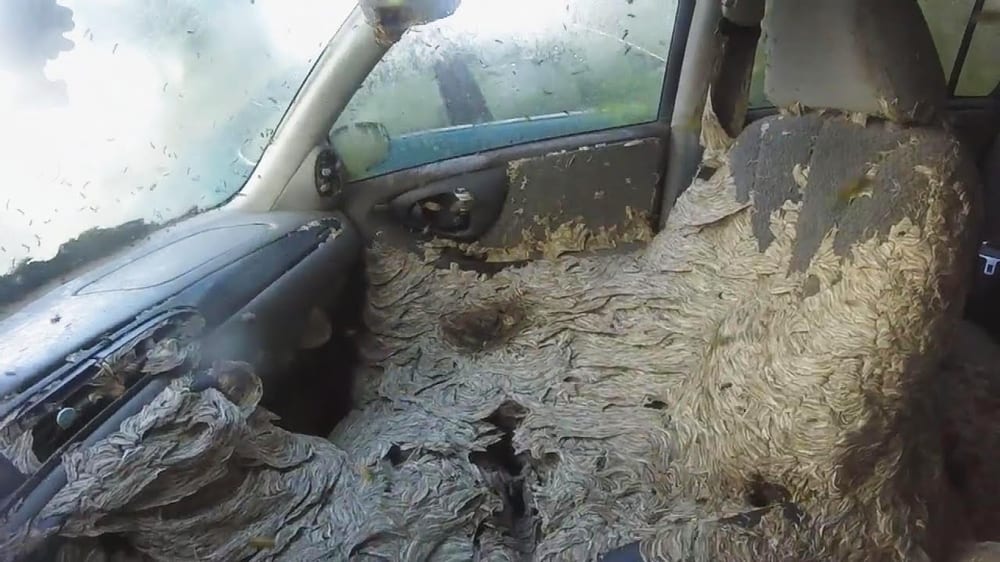
Wasp nest "taking over" a car. I always find the langauge around insects interesting. As though they are supposed to be aware of where human spaces exist versus natural spaces. Insects in human spaces are most often described as taking over, infesting, swarming, destroying.
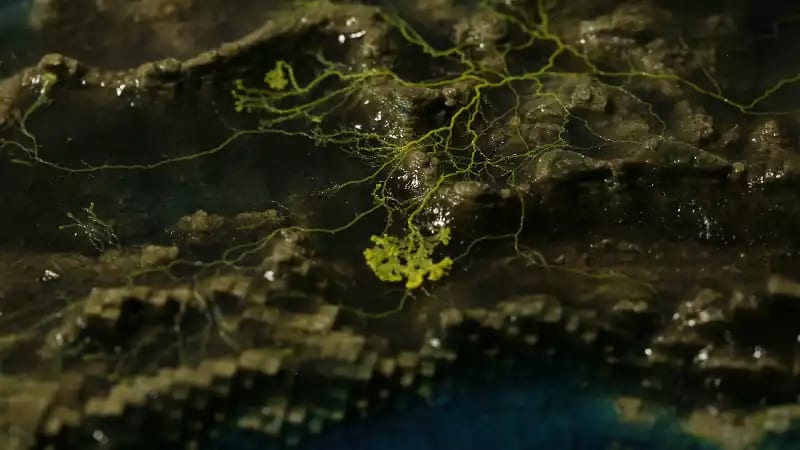
Heather Barnett, Resilient Topographies #1: the peninsula of Paljassaare (film still) © Heather Barnett (in collaboration with ecologic studio)
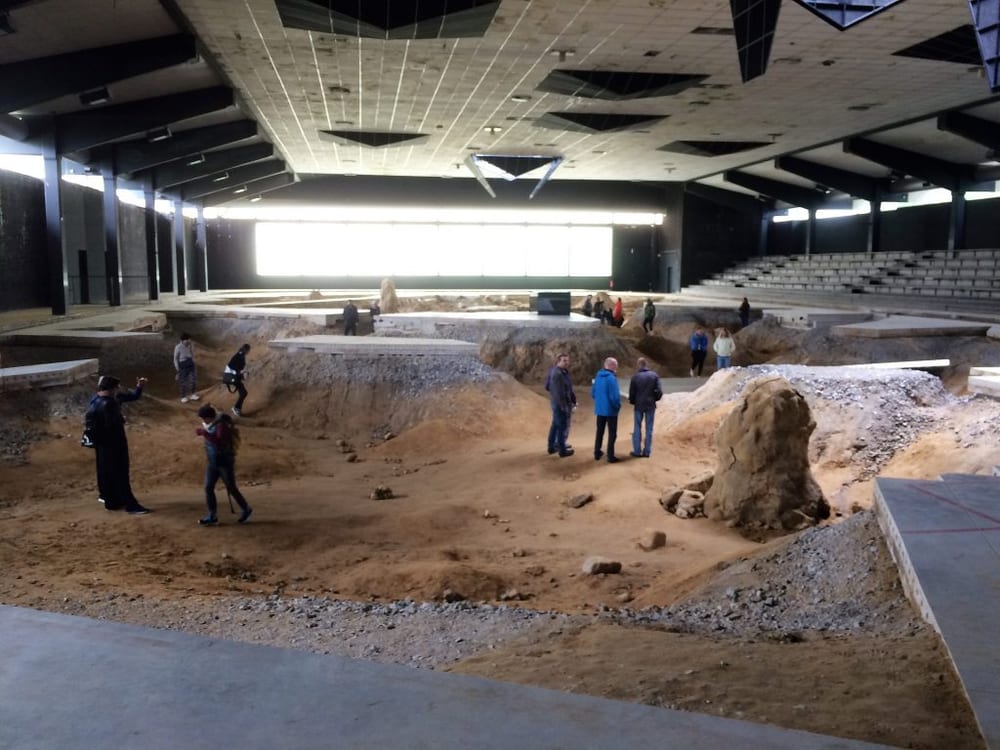
Artwork | Pierre Huyghe, After ALife Ahead for Münster’s Skulptur Projekte (2017). A time-based bio-technical system in a former ice rink that closed in 2016. This installation asked, what does a material want? It questioned where human intervention ended and material autonomy began. The materials continued to visibly interact when no audience was participating. It was ‘an artwork that is slowly spiralling into something else, moving away from its creator, and only giving off little glimpses of its operations as it evolves. Through October 1, when Skulptur Projekte closes, rain will keep flowing in, the algae will still grow, and the landscape will continue to change.' Throughout the installation: 'An incubator holds cancer cells whose rate of growth is determined by various measurements that sensors are taking of the space, which is also home to chimera peacocks and bees (though I have to admit that I saw neither during my visit). As the cancer cells change, they guide the behavior of black shapes that appear in an augmented reality app that visitors can download onto their phones. “What you have there is really a network of self-organizing systems,” Huyghe said. “They are in constant displacement. They grow, they evolve, they shift"' The quotes above were taken from a review by Andrew Russeth for Art News titled Constant Displacement: Pierre Huyghe on His Work at Skulptur Projekte Münster (still available online).
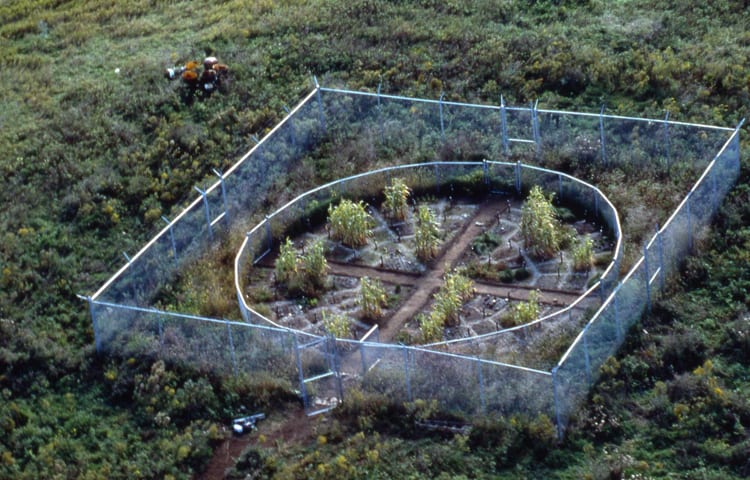
Mel Chin, 1991-ongoing, plants, industrial fencing on a hazardous waste landfill. An ongoing project in conjunction with Dr. Rufus Chaney, senior research agronomist, USDA. "field test using special hyperaccumulator plants to extract heavy metals from contaminated soil. Scientific analysis of biomass samples from this field confirmed the potential of “Green Remediation” as an on-site, low-tech alternative to current costly and unsatisfactory remediation methods. Despite soil conditions adverse to metal uptake, a variety of Thlaspi, the test plant with the highest capacity for hyperaccumulation, was found to have significant concentration of cadmium in its leaves and stems." - Mel Chin website
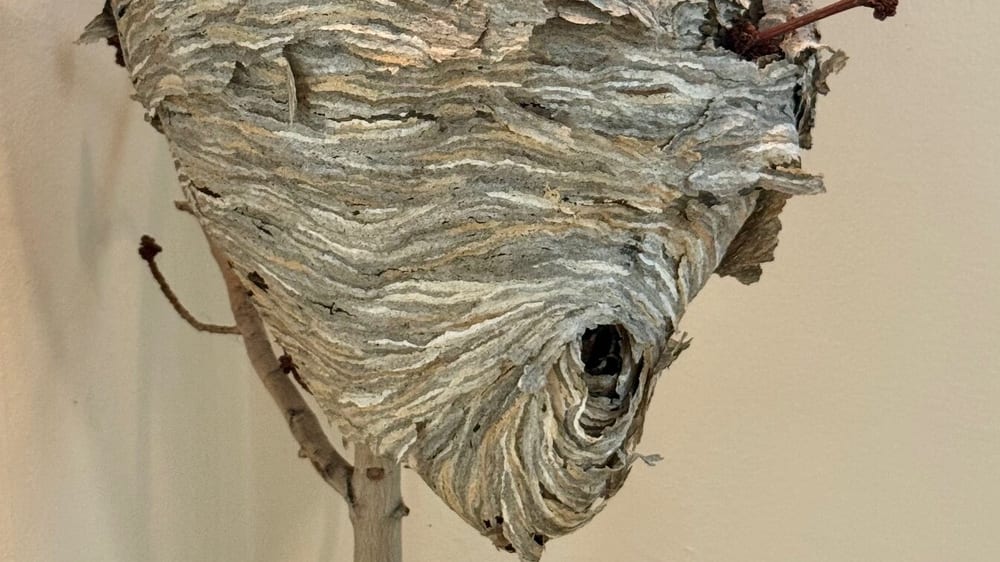
Wasp nest | I often think about how insects created the technology of paper millions of years before humans. Wasps scrape dead fibres from trees and human-made wooden structures. They use their saliva to chew the fibres before regurgitating them and spreading the strips to form a nest.
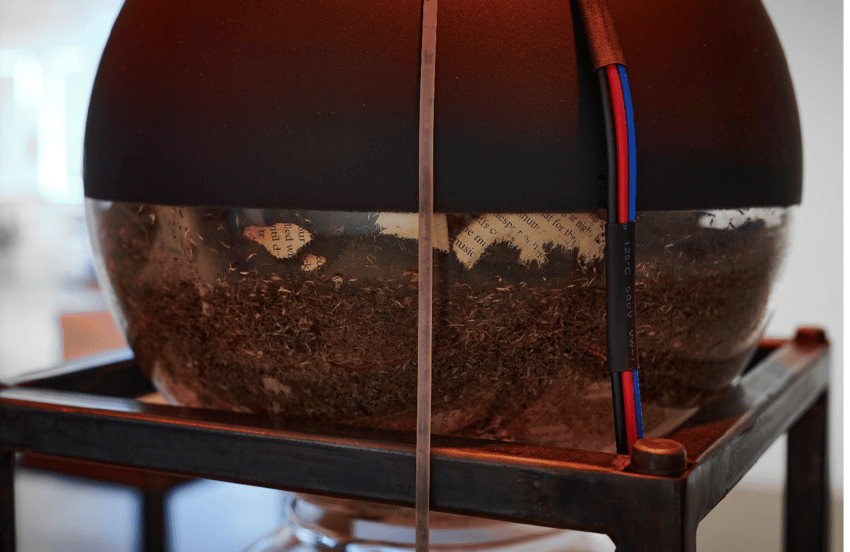
Nolan Oswald Dennis, Garden for Fanon, 2021. A sculpture comprised of "a set of steel stands, glass globes, izinkhamba pots, machine and human protocols for caring for a community of earthworms. The installation is assembled to provide an ideal environment for the community of earthworms to work through the body of the Pan-African philosopher and psychologist Frantz Fanon’s final book, ‘The Wretched of the Earth’. This garden is an ideal environment in the sense of a utopia. It sits apart from the world. A fabricated island as a model for a kind of landlessness that writhes and recreates the land, let’s say the world, on its own terms. Our role here is not to observe or contemplate the garden as a work of art but to tend to the conditions that make the garden possible. Simply, one must feed the worms, one must maintain a conducive temperature, humidity and illumination. What comes at the end is a result of what we put in, and what we don’t. Some soil and leachate and more worms and some time spent together caring.” - Goodman Gallery
A handful of soil has more living organisms in it than there are people on the planet. Billions of organisms. That’s healthy soil. The soil is made up of particles that come together, and they are held together by a sticky gluey substance that is excretions and exudates from both plants and also insects and microbiology that live in the soil. The microorganisms that live in the soil depend on air as much as we do, and so having air pockets in the soil which comes from healthy roots, healthy plants, tapping down into the soil, allowing airways to develop. And also those airways being created by things like worms crawling their way through the soil.
— Journey Through a Cow, BBC R4 (2026)
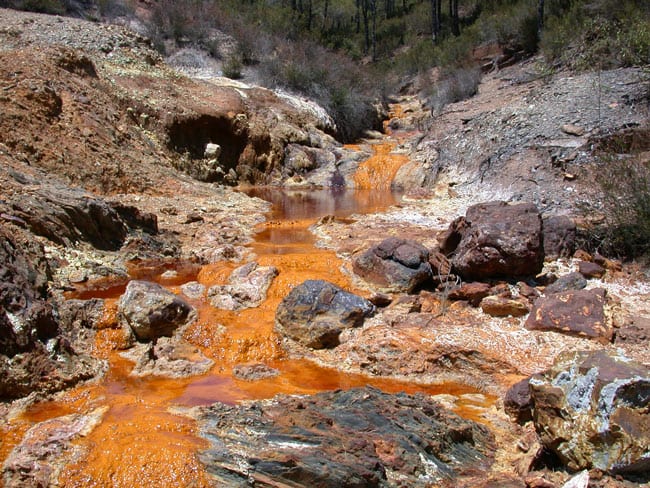
Rio Tinto river | Europe's largest open-cast mining area (mined for copper, tin, silver extracted from oxidised sulphides, mined in Tartessian times, heavily by the Romans, and still to this day) is upstream. According to NASA the Stained River "flows through an area unusually rich with sulfide ore deposits, which formed hundreds of millions of years ago when volcanoes were active in the area. When the metals in these buried deposits are exposed to water and oxygen, they produce acidic runoff that flows into streams and rivers. While the acid has made the Rio Tinto inhospitable to most types of life, it has made it more hospitable to sulfide-consuming bacteria and other extremophiles that amplify the acidification process. These organisms give the river its red hue by producing ferric iron, a rust-colored substance"
Salmon is the colour of a wild fish that is neither wild, nor fish, nor even salmon. But they are not alone. The changing tones of many other species are warning signs of an environmental crisis, where the colours of life—flesh, scales, feathers, skin, leaves, wings—are increasingly altered by synthetic substances ingested and absorbed by organisms. These shifts are both symptoms and signals of profound ecological and metabolic transformations around and inside us. Salmon: A Red Herring interrogates the colours we expect in ‘natural’ environments, compelling us to confront how human interventions distort the perception of colour as we change the planet.
— 2020, SALMON: A RED HERRING, Cooking Sections
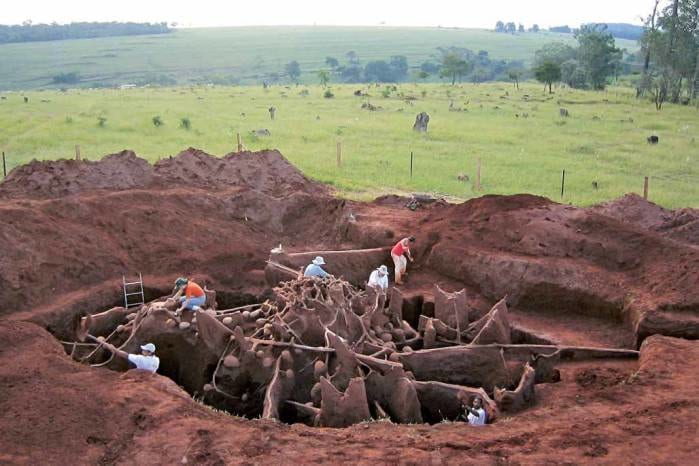
Concrete poured into the subterranean portion of a giant leafcutter ant nest in Brazil