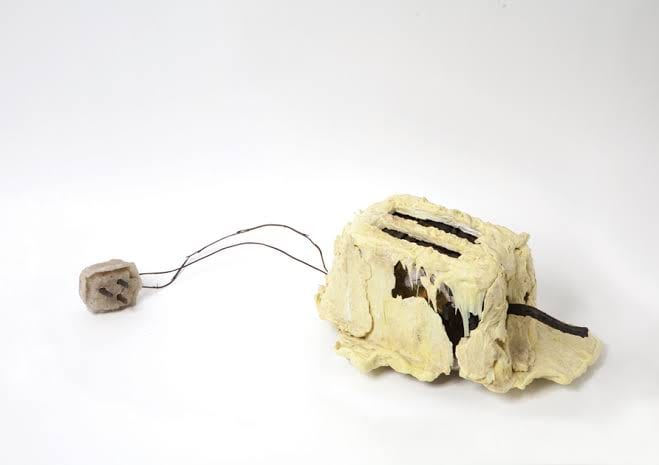
In his book The Toaster Project, Thomas Thwaites sets out to make a toaster from scratch - souring the raw materials from the earth, creating iron, mining quartz & making plastic. He starts by taking apart a £3.94 Argos toaster (the model which he will base his toaster on). This process of reverse engineering reveals that the toaster contains hundreds of parts. Seperating these parts into materials is complex when you factor in the various assemblages, chemically different types of plastic and various inclusions of dyes mixed in with other materials. I love this project becasue it perfectly illustrates the idea that we know where nothing comes from, and we pay staggeringly little for the materials and extractive processes that we are consuming. These technologies have become so cheap that the price implies they are disposable, yet, as we learn on p.154 “the cheap toasters I’ve taken apart have been hand soldered”. It isnt just the extensive material parts, the journey all of these materials have travelled to become part of the toaster, its also the invisible and underpaid labour that is being undervalued. The book highlights how “The point at which it stopped being possible for us to make the things that surround us is long past.” When he is journeying to extract iron ore, copper and mica, we are reminded of how we’re so used to thinking of materials sharply distinct from one other, but it's easy to forget that in the messiness of the real world, pretty much everything is mixed together. This 'heroic attempt' is an impossible yet satisfying task. And amazingly the book is Open Source on Thwaites' website.
The idea that a material can hold, release, nourish, scaffold or sustain resonated deeply with themes already present in my practice, those of care, memory, decay, and the shifting boundaries between bodies and the environments that support them, treating materials as collaborators with lifespans, vulnerabilities and agency rather than static entities. How might we treat materials in ways that keep them “alive”? What conditions allow them to thrive? What do we cling to, transform or let go? And what kinds of materials, and what kinds of time, might sustain us differently?
— How might we treat materials in ways that keep them “alive”?, Claire Bailey, Science Gallery
What does it mean to give agency to a material, to follow the material and act with the material?
— Petra Lange-Berndt, How to Be Complicit with Materials, Whitechappel Gallery’s Materiality.
What, then, of the air? When you breathe, or feel the wind on your face, are you engaging with the material world? When the fog descends, and everything around you looks dim and mysterious, has the material world changed, or are you just seeing the same world differently?
— Tim Ingold, Materials against Materiality, (2007) p13
From a critical perspective, the term ‘material’ describes not prime matter but substances that are always subject to change, be it through handling, interaction with their surroundings, or the dynamic life of their chemical reactions.
— Petra Lange-Berndt, How to Be Complicit with Materials, Whitechappel Gallery’s Materiality.
Matter is unruly as a concept. No matter where one dips in along its historical trajectory, a variant meaning is readily available. The word is both a convenient catch-all for the ultimate stuff of existence and a specific ingredient lodged in the substratum of the real. Matter is regarded both as an inert basal layer embedded in a hierarchy of bodies and a quivering multitude obscured by a taxonomic distinction between the animate and inanimate.
— Matter, Christopher L. Witmore, 2017
The difference between a marble statue and a rock formation such as a stalagmite, for example, is not that one has been made and the other not. The difference is only this: that at some point in the formative history of this lump of marble, first a quarryman appeared on the scene who, with much force and with the assistance of hammers and wedges, wrested it from the bedrock, after which a sculptor set to work with a chisel in order, as he might put it, to release the form from the stone. But as every chip of the chisel contributes to the emergent form of the statue, so every drop of supersaturated solution from the roof of the cave contributes to the form of the stalagmite. When subsequently, the statue is worn down by rain, the form-generating process continues, but now without further human intervention.
— Tim Ingold, Making: Anthropology, Archaeology, Art and Architecture, (2013), p21
Empirically speaking, we are all made of star stuff. Why aren’t we talking more about that? Materials never leave this world. They just keep recycling, recombining. That’s what you kept telling me when we first met - that in a real, material sense, ‘what’ is really made from ‘where’. I didn’t have a clue what you were talking about, but I could see you burned for it.
— Nelson, Maggie. The Argonauts. Minneapolis: Graywolf Press, 2015. P.122
“We see the building and not the plaster of its walls, the words and not the ink with which they were written. In reality, of course, the materials are still there and continue to mingle and react as they have always done, forever threatening the things they comprise with dissolution or even ‘dematerialization’. Plaster can crumble and ink can fade. Experienced as degradation, corrosion or wear and tear, however, these changes – which objects undergo after they are ‘finished’ – are typically attributed to the phase of use rather than of manufacture. As the underbelly of things, materials may lie low but are never entirely subdued. Despite the best efforts of curators and conservationists, no object lasts forever. Materials always and inevitably win out over materiality in the long term.”
— Tim Ingold, Materials against Materiality, Cambridge University Press, 2007