← Back
Story
1
Story
2
Link
3
Image
4
Image
5
Image
6
Image
7
Quote
8
Quote
9
Link
10
Image
11
Submit an entry
Dust
11 items

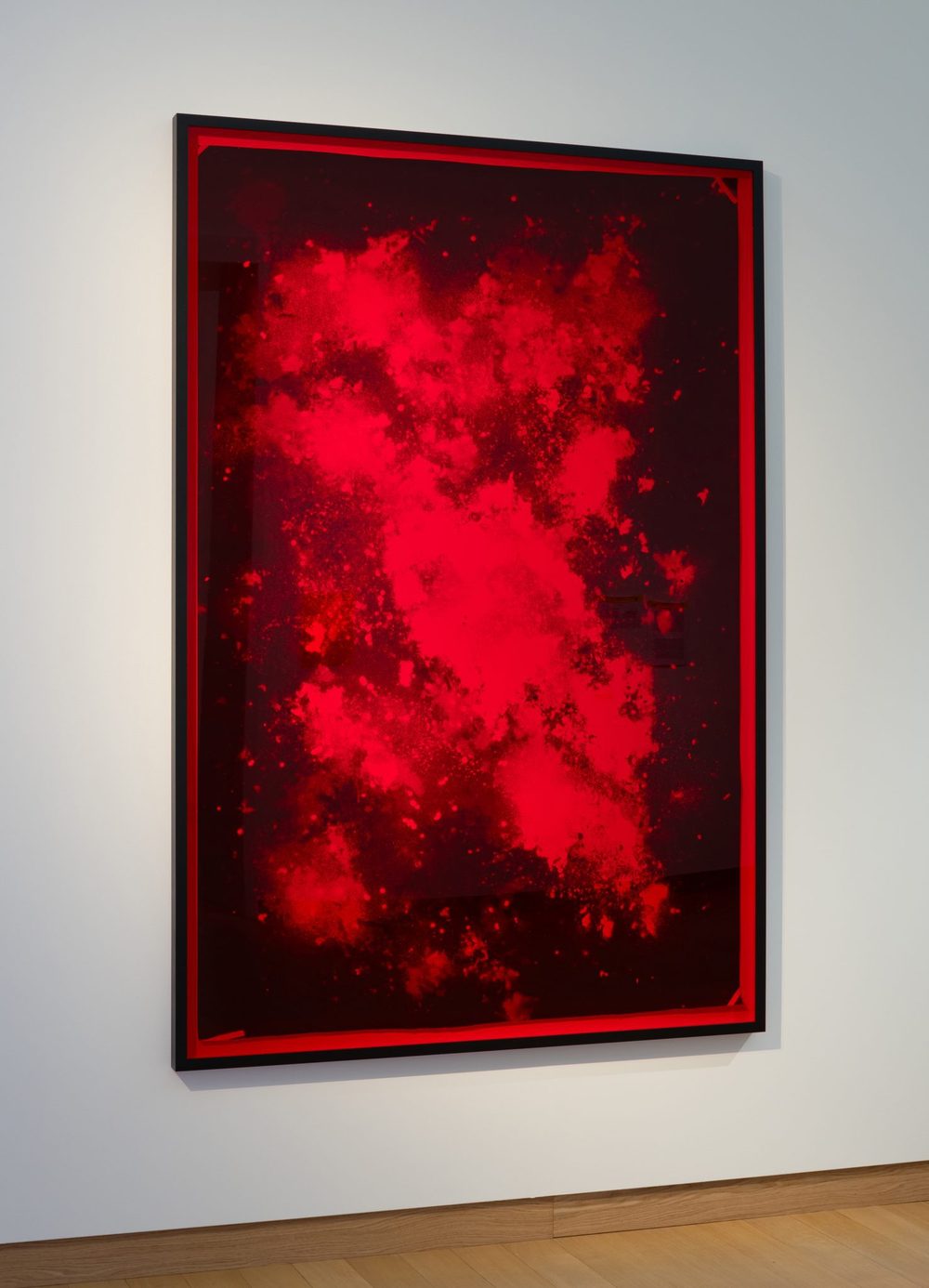
Artwork | Semâ Bekirovic, Unfixed Galaxies, 2018-2024 (framed). Unfixed analogue photographic prints, framed behind red glass. "For the work Unfixed Galaxies Bekirović asked the cleaners of the Stedelijk Museum to save the dust from their vacuum cleaner bags. She placed this dust on a large sheet of photographic paper in a dark room. The paper was then exposed, developed, but not fixed. As a consequence the images remain light-sensitive, meaning that they will disappear completely if exposed to daylight for any length of time. This process of light exposure is slowed by displaying the photograph behind red plexiglass. Red light does not affect the photographic process. Although, eventually, the image will fade away. Bekirović sees the vacuum cleaner dust as a gathering of visitors, employees, and artworks. The dust largely consists of skin cells and small particles of art, after all. By developing and not fixing the prints, Bekirović emphasizes the transience of both people and artworks."
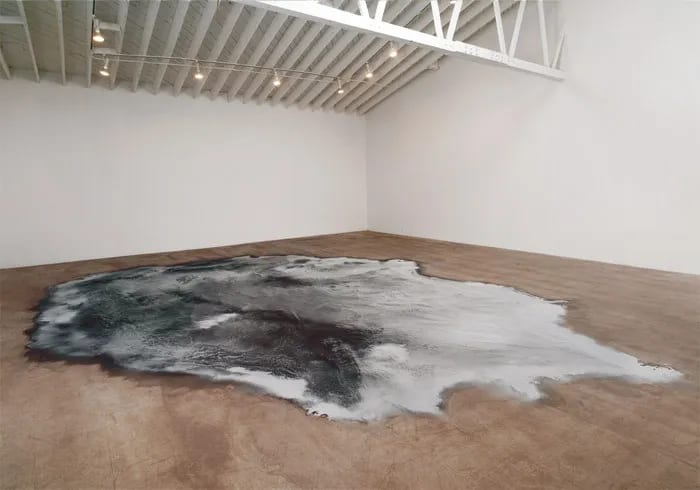
Roger Hiorns, *Untitled*, 2008-, atomized passenger aircraft engine, dimensions variable.
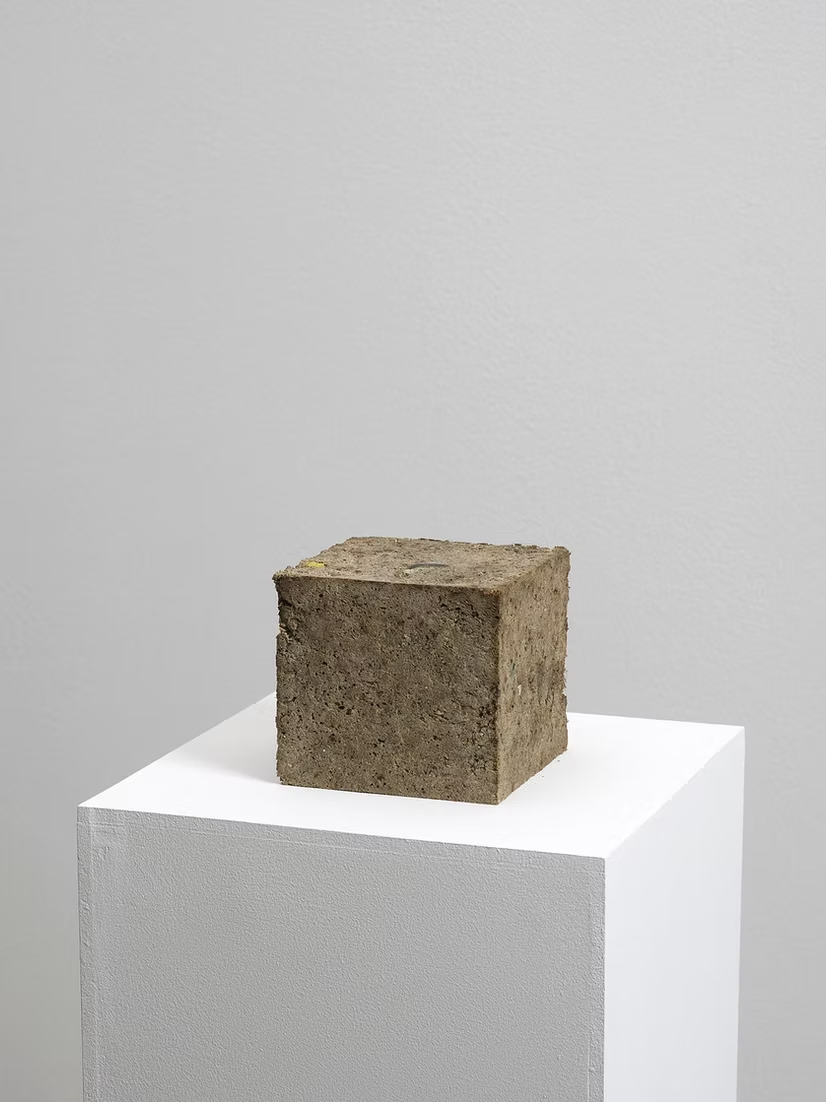
Artwork | Gala Porras-Kim, 'The Michael C. Rockefeller Wing at the Met 1982–2021' fragment, 2022. 9.5 x 9.5 x 9.5cm 'The Michael C. Rockefeller Wing at the Met 1982–2021 fragment is a cube made of dust and residue collected during deinstallation in the eponymous gallery at the Metropolitan Museum of Art. It sheds light on the physical conditions surrounding art while also questioning what is auxiliary to the “object” and under what circumstances the residue of a culture becomes an artifact.'
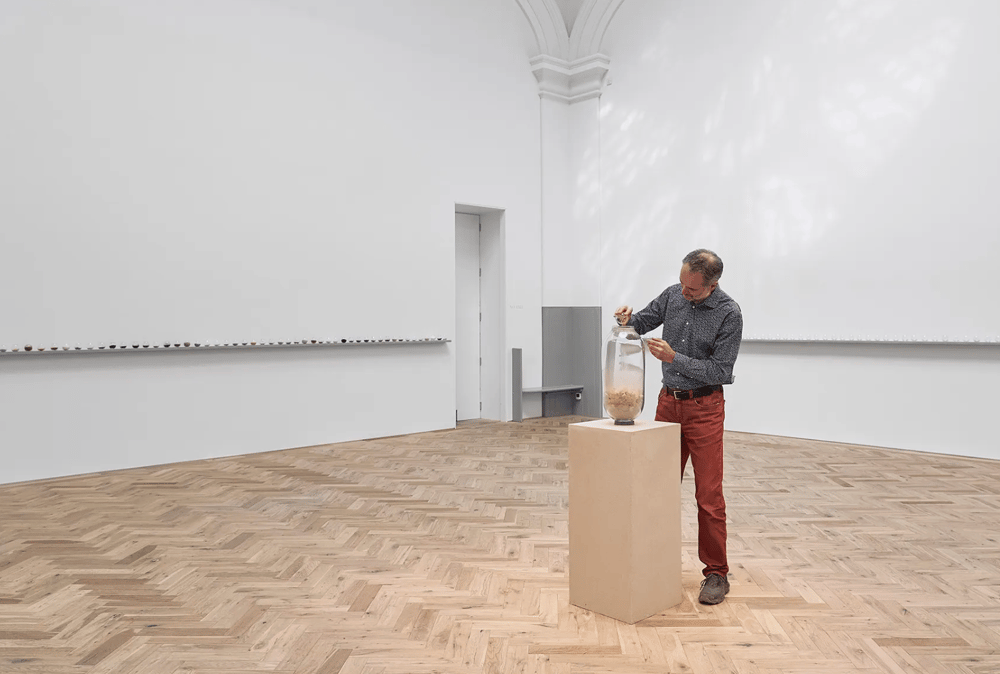
Artwork | Kate Paterson, Requiem, 2022 'Requiem tells of the birth and life of our planet in a single object – an object that uses dust gathered from material dating from pre-solar times to those of the present. A large glass urn, the ancient form of funerary vessel, sits at the centre of the gallery. Around the walls a long shelf holds a series of small glass vials, 364 of them in all, each containing a tablespoon of dust. Each is a layer of time waiting to be poured into the urn by members of the public, and by invited guests. The dust has been obtained through collaboration with institutions and collections worldwide, and collectively, the vials map the story of the Earth from before its existence to the present day, and offer a lament for the planet, a warning, a requiem on the theme of extinction. The pouring will begin with a layer pre-solar dust from the oldest of meteorites, stretching back across the furthest distances of time and place, then the asteroid Vesta, a reminder of our planet’s origin still visible as the brightest asteroid in the night sky. There follows a slow unfurling of planetary history, from the oldest earthly rock formation of the 4.5-billion-year-old Pre-Cambrian era to the first creatures to open their eyes, the first flowers to flower, the first skeletal structures and the slow emergence of humanity’s antecedents from ocean to land. There are the crushed-to-dust remnants of our most archaic ancestors, from the earliest hunter-gatherers of Doggerland, through cultures and epochs long gone – Phoenician, Bactrian, Inca, Hellenistic, Roman, Pre-Columbian, Viking – each pouring of dust taking us layer by layer through the origins of everything, and the extinction of so much that is left in our wake.' Requiem was commissioned by the National Glass Centre, Sunderland Culture, and Ingleby Gallery. image: [https://katiepaterson.org/artwork/requiem/](https://katiepaterson.org/artwork/requiem/)
Empirically speaking, we are all made of star stuff. Why aren’t we talking more about that? Materials never leave this world. They just keep recycling, recombining. That’s what you kept telling me when we first met - that in a real, material sense, ‘what’ is really made from ‘where’. I didn’t have a clue what you were talking about, but I could see you burned for it.
— Nelson, Maggie. The Argonauts. Minneapolis: Graywolf Press, 2015. P.122
Earth to earth, ashes to ashes, dust to dust
— Church of England. The Book of Common Prayer. Oxford: Oxford University Press, 2004.
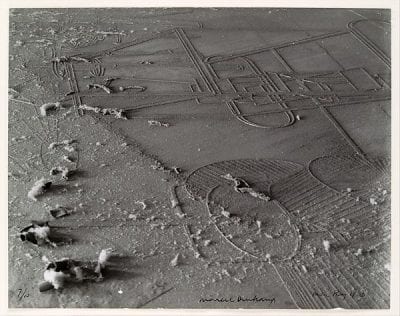
Man Ray, Dust Breeding (Duchamp's Large Glass with Dust Motes) from 1920 "is a document of The Large Glass after it had collected a year's worth of dust while Duchamp was in New York. The photograph was taken with a two-hour-long exposure that beautifully captures the complex texture and diversity of materials that lay atop the glass surface. Dust Breeding marks a pivotal phase in the development of Duchamp's masterpiece. After the photograph was taken, Duchamp wiped The Large Glass almost entirely clean, leaving a section of the cones covered with dust, which he permanently affixed to the glass plate with a diluted cement." - The Met