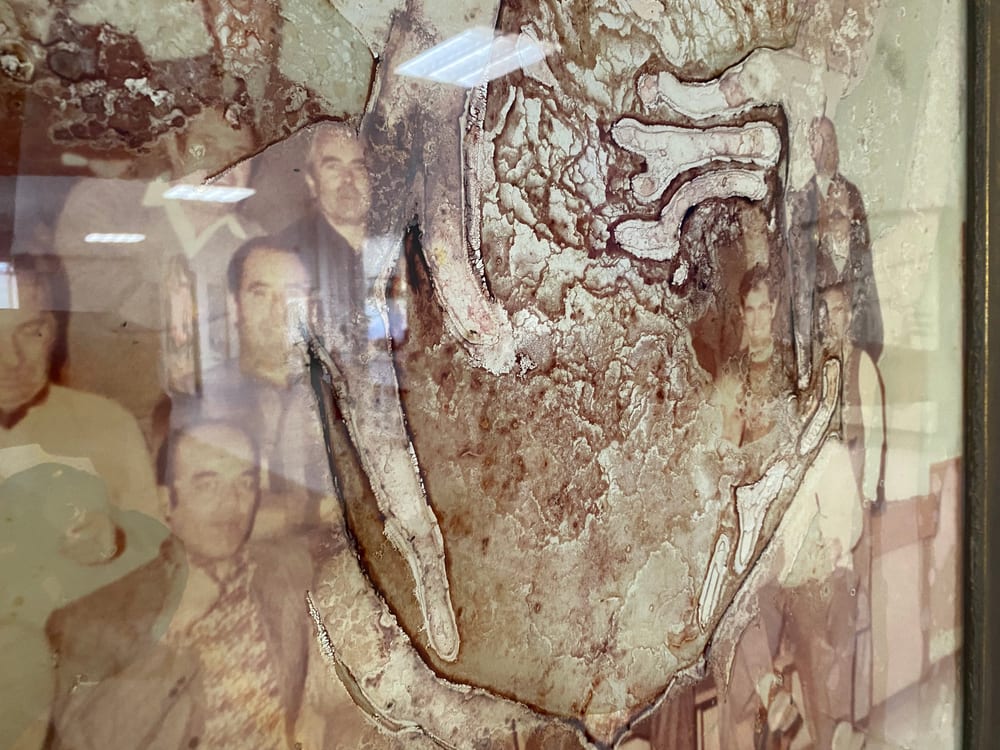
One of my favourite objects at PADA Artist Residency in Barreiro, Lisbon. It is a large framed photograph haning on the walls of the studios. It was found in the abanodoned industrial area. The faded photo depicts a historic group of people who once worked in the indstrial park. The ink has bled over the years while the photgraph was exposed to the elements.
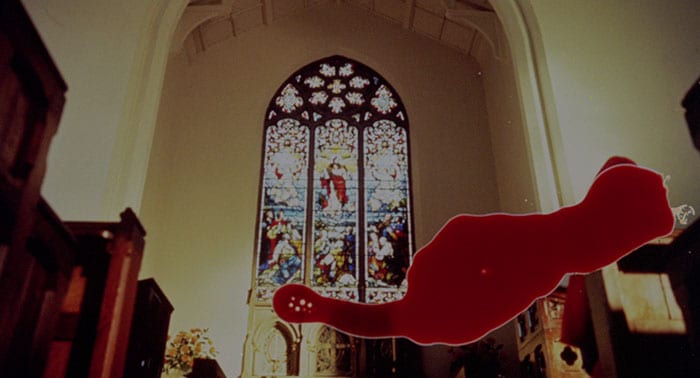
Still from Don't Look Now (1973). While John handles a photographic slide of a Venetian church, he knocks over a bottle of blood red ink which flows across the image, pooling over a small figure sitting in a pew. The panic of the accident causes him to instintively react to the danger (he is unaware of) currently taking place outside.
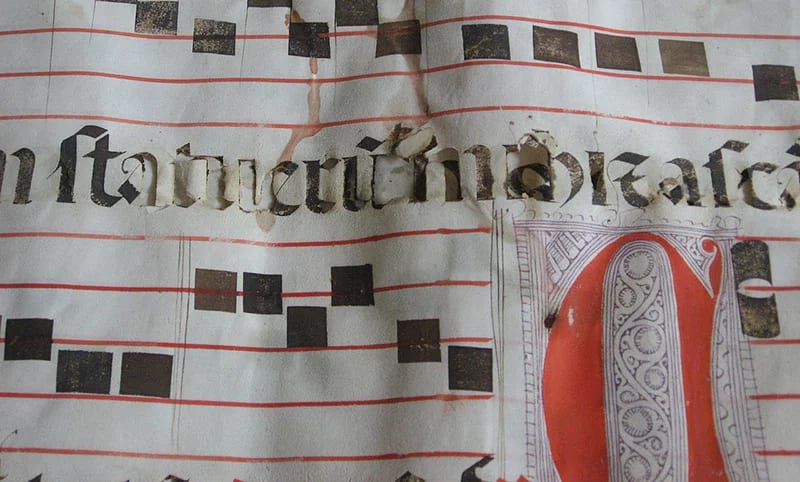
Iron gall ink corrosion on a manuscript from the Church of St Francis, Évora, Portugal
.jpg)
The Rumblings, Muckle Flugga, Shetland, Norman Ackroyd CBE RA, 2013, etching, 49.5 x 78cm © Norman Ackroyd
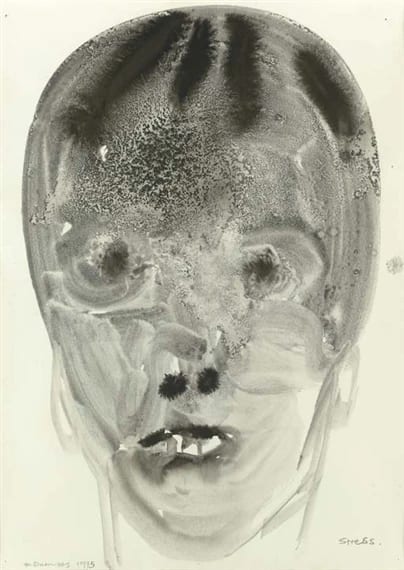
Marlene Dumas, Stress, 1995, ink on paper
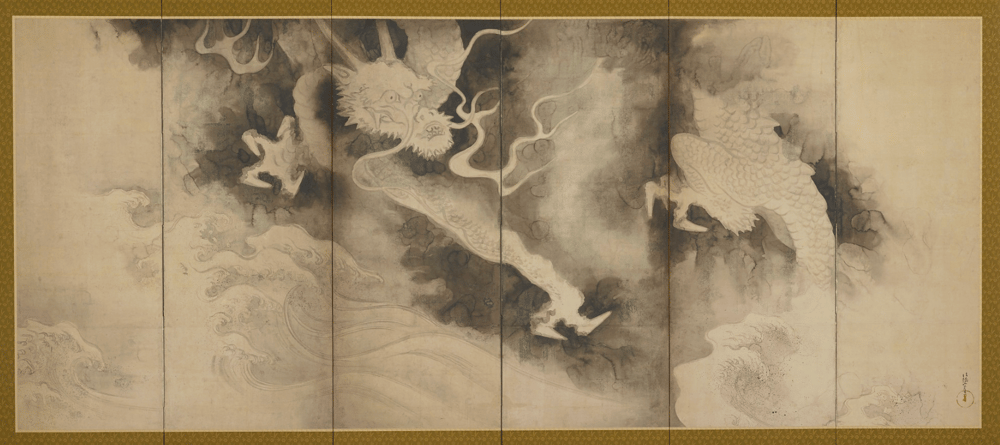
Dragons and Clouds, 雲龍図屏風(左隻), Ink
The scribes used iron gall ink made from growths on oak trees caused by parasitic wasps. The galls were crushed and mixed with water and honey, and sometimes with vitriol—sulphuric acid—gum arabic, which is a binding agent, and iron shavings from the bottom of cauldrons to make blue/black ink. Over time, the ink rusts, so the writing on the four Magna Cartas is now brown. The scribes used a quill pen made from the thick end of the feather from a large bird, usually a goose. The feather was sharpened and split at one end to create a nib, which had to be frequently re-sharpened. If the scribe made a small mistake, a knife could be used to scrape off a thin layer of parchment and provide a clean surface.
— The Making of The Magna Carta, UK Parliment
In Japanese, the Kanji character of black is written as 黒 and the four dots at the bottom represent fire as how the soot is fired and produced. While 墨, Sumi (black ink) is made by kneading animal glue and soot that is produced by burning oil or pinewoods, the character for Sumi is a combination of 黒 (black) and 土 (earth).
— Vintage Sumi Ink: Exploring the Beauty of Kogaboku. Pigment Tokyo
Lamp Black is a form of carbon black. It is essentially soot and is composed of finely particulate amorphous carbon. The pigment is cheap and easy to make; all you need is a flame and a fuel source and a surface for the soot to accumulate on. This pigment must have been recognised from the earliest dates of human cognition. It has been recognised in paintings of all periods and all regions and was also widely used as a cosmetic and as a tattooing ink. Lamp Black has been the main ink used for writing and calligraphy in many cultures (although iron gall inks and sepia have also been used from the Roman Periods onwards). Nevertheless, Lamp Black was the main constituent of India Ink (but note that modern India Inks are made with a mixture of organic dyes). The best lamp blacks are made from burning tree resins, pitch or tar, or burning the wood of resinous trees such as pine’ ‘‘Blackness’ depends on factors including particle size and the degree of reflectivity/absorption of light. Ivory black has always had the reputation as the finest of black pigments, but lamp black is readily available, inexpensive and easy to make and is a fine, black ink
— Lamp Black: Digital Humanities, Ruth Siddall (2016), The Pigment Timeline Project, UCL
Lampblack is a form of carbon. You can think of it as something like very, very finely divided charcoal. Because it is so incredibly fine, a small amount covers a large area giving an intense black color. It forms the basis of the best traditional black inks and has been used to many other ends from shoe polish to blackening gun sights.
— Lampblack, what it is and what it's good for. 2024, Skill Cult
Plants, too, provide an endless source of materials for further processing and transformation. One has only to enumerate, for example, all the different materials that can be derived from trees, including wood, bark, sap, gum, ash, paper, charcoal, tar, resin and turpentine. Other flowering plants and grasses give us cotton, flax, jute and papyrus. […] Many materials in common use are derived from the unlikely combination of ingredients from an astonishing variety of different sources. […] ink, an essential material for the medieval scribe. Two kinds of ink were used. One was made of lamp- black mixed with gum. For the other, which came into general use from the 12th century, the principal ingredient was the oak apple. This is the round, marble-sized tumour that often grows on the leaves and twigs of oak trees. It is formed around the larva of the gall wasp that has laid its egg in the tree bud. The oak galls are collected, crushed and either boiled or infused in rainwater (or white-wine vinegar). The other main ingredient is copperas, manufactured by the evaporation of water from ferrous earth, or by pouring sulphuric acid over old nails, filtering the liquid and mixing it with alcohol. The copperas is added to the oak-gall potion and thoroughly stirred with a stick from a fig tree. This has the effect of turning the solution from pale brown to black. Finally, gum arabic – made from the dried-up sap of the acacia tree – is added in order to thicken the concoction (de Hamel 1992, 32–33).
— Tim Ingold, *Materials against Materiality*, Cambridge University Press, 2007