(Un) Productive Bodies
Dr Ellie Barrett
(Un) Productive Bodies by Dr Ellie Barrett
Published 24 June 2026
Originally published in Ellie Barrett’s blog. Shared with authors permission. Trigger warnings: postpartum haemorrhage, infertility.
Trigger warnings: postpartum haemorrhage, infertility.
Author’s note: this blog was never really meant to be a place to talk about my personal life. If you’ve been following my writing, though, you’ll already know about the profound impact the birth of my daughter has had on how I make work and think about making work. “Personal as political” has long been a feminist mantra: the ways we experience social interaction on an individual level can nurture our awareness of how the political plays out in the everyday. Storytelling is powerful for this reason. And so this post is the most personal I’ve ever been in this space. There’s a lot I’m sharing publicly that only my closest people know. It’s nerve wracking. I hope that it’s taken with kindness but, more importantly, I hope that using my experiences of making, my daughter and my body to process events in my life will resonate with someone, in some way. If mine are like yours, we’re not alone.
The myth goes that sculpture was “invented” in ancient Greece by a Corinthian potter (1). His daughter’s love was sailing to sea and on their final encounter, she used charcoal to trace the silhouette of his face cast on the wall by the firelight. Wanting to give her some relief from her mourning, the potter pressed clay into the lines of the chin, lips, nose and forehead to create an object. Something to hold on to. Something out of nothing. Sculpture is a thing in place of an absence.
Presence where there used to be a space.
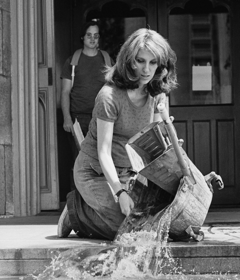
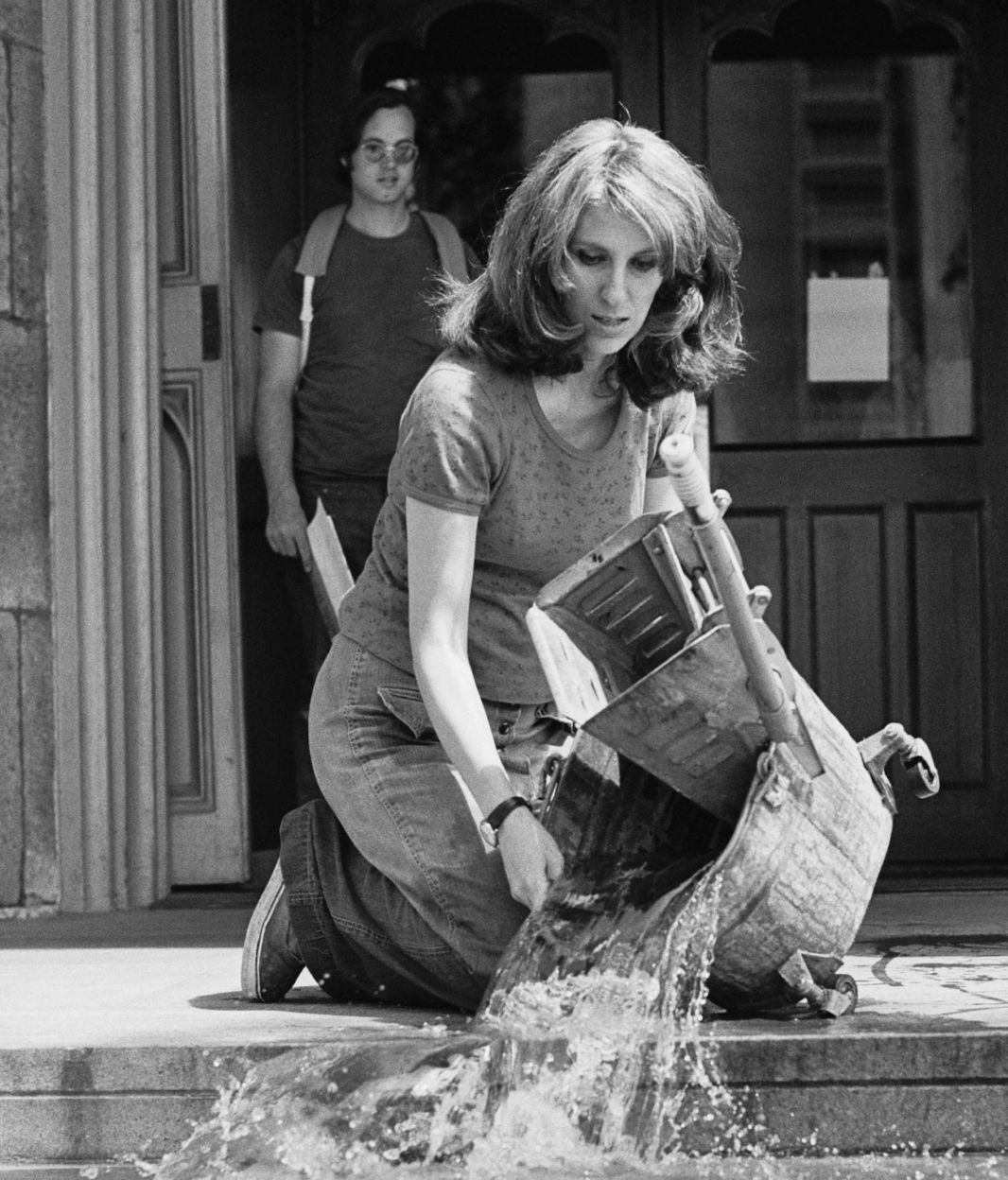
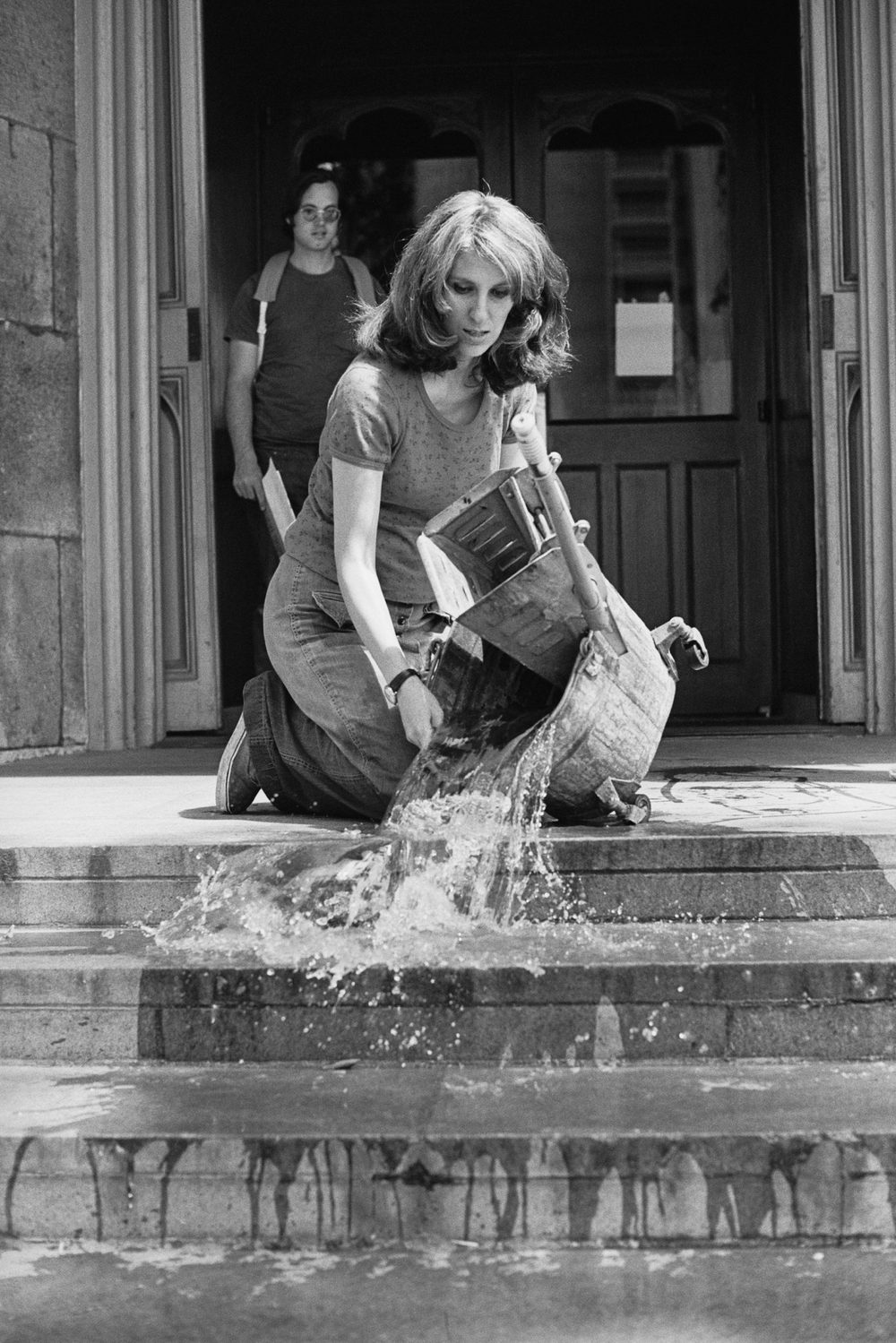
“Social sculpture” grew out of the 1960s when Joseph Beuys declared “every man is an artist” (2). In many ways, this phrase has dated badly, entrenched in misogynist language. But in others, it is still straining to be true. Social sculpture encompasses the entire “process of living”. Thoughts, actions, conversations, things. Anyone is an artist. Mierle Laderman Ukeles washes the steps of the Guggenheim. Mary Kelly documents her baby’s nappy changes and feeds. Sculpture is relationships between bodies and objects.
Earlier this year, I watched Professor Griselda Pollock’s keynote lecture at a conference for women making abstract sculpture (3). Sculpture, she said, comes from the gradual loss of our mother’s body as we are birthed from the womb and then grow out of infancy. We all possess a drive to reform early tactility. Making with our hands, manifesting the sensual. Gentle collision of bodies. Sculpture is the feeling of being held.
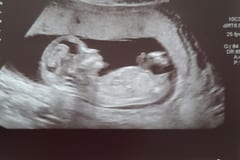
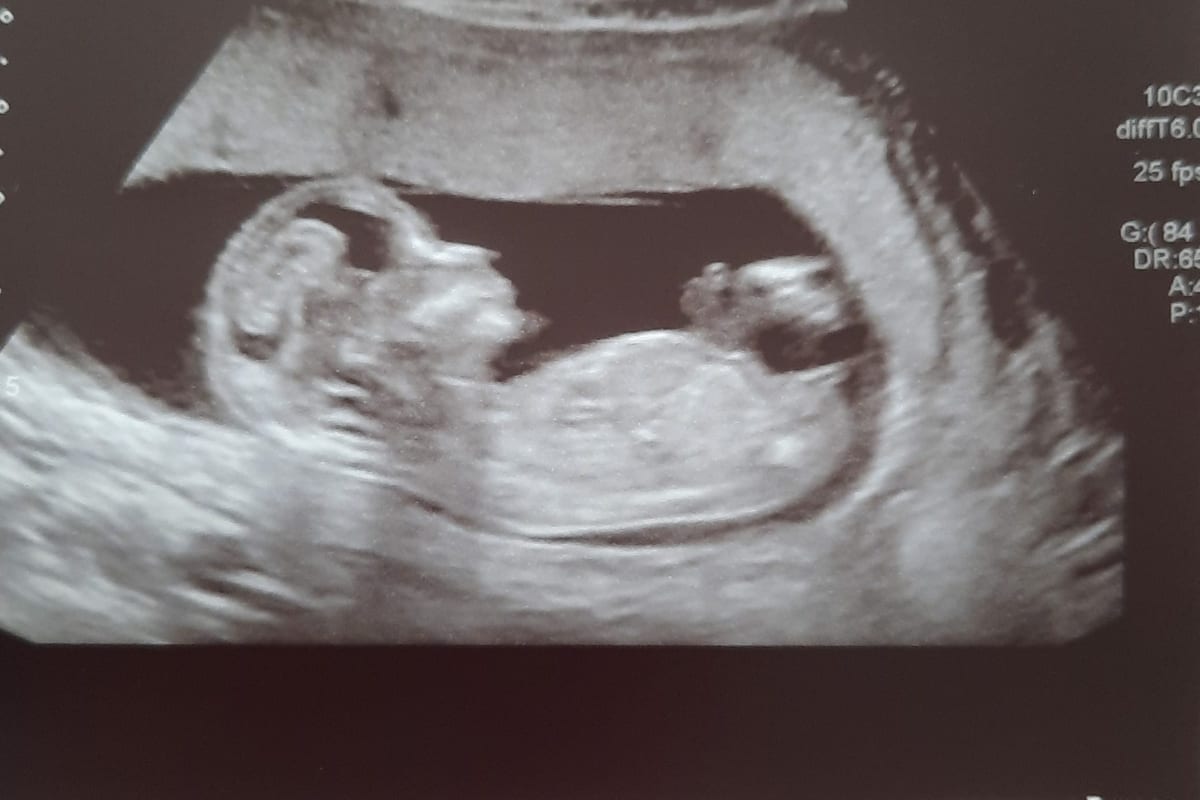
Three weeks postpartum, a rush of bright, red blood gushed from me as I stood up from watching TV on the sofa. I felt a river spring down my legs. No warning, no sensing anything was wrong. No pain. The maternity unit coached me to call an ambulance, and the 999 operator stayed on the line with me until the paramedics arrived. I squatted over an old towel by the dining room table, not even bothering to take off my trousers which were dyed slowly-browning crimson. Prior to this, I’d been passing clots, slithering out, dark and shining like globules of onyx. I saved them in maternity pads like treasures to show the midwives. I stayed in hospital overnight for an operation in the morning. My daughter slept with me in the hospital ward. I fed her as well as I could, holding her against the pull of the cannulas awkwardly tugging at my veins. Shreds of placenta still clinging to the walls of my womb were forcibly removed whilst I lay unconscious.
New materialist philosopher Jane Bennett imagines all things - entities, events, environments - as “assemblages” (4). Not one thing acting alone, but all things tied together. A power cut, Bennett explains, is not the result of a single electrical fault but the combined agencies of weather, equipment, wiring, electrical providers, houses, cities and people, all working unknowingly together towards an unintended outcome. Will spread out across humans and non-humans. New materialist ideas change the way we think about gender, pregnancy and parenthood. Paula McCloskey generously shares her experience of miscarriage and intrauterine imagery as a “connection between the human and the non-human.” (5). Before we form consciousness, we are vibrant matter. Kate Boyer configures early motherhood and infant feeding as “a relational practice that is achieved through engagements with human and non-human others.” (6). Breastmilk changes its chemical contents - different antibodies and nutrients - depending on what the baby needs. There is no human intention involved, just matter. The body’s capacity to nurture unfolds without consciousness.
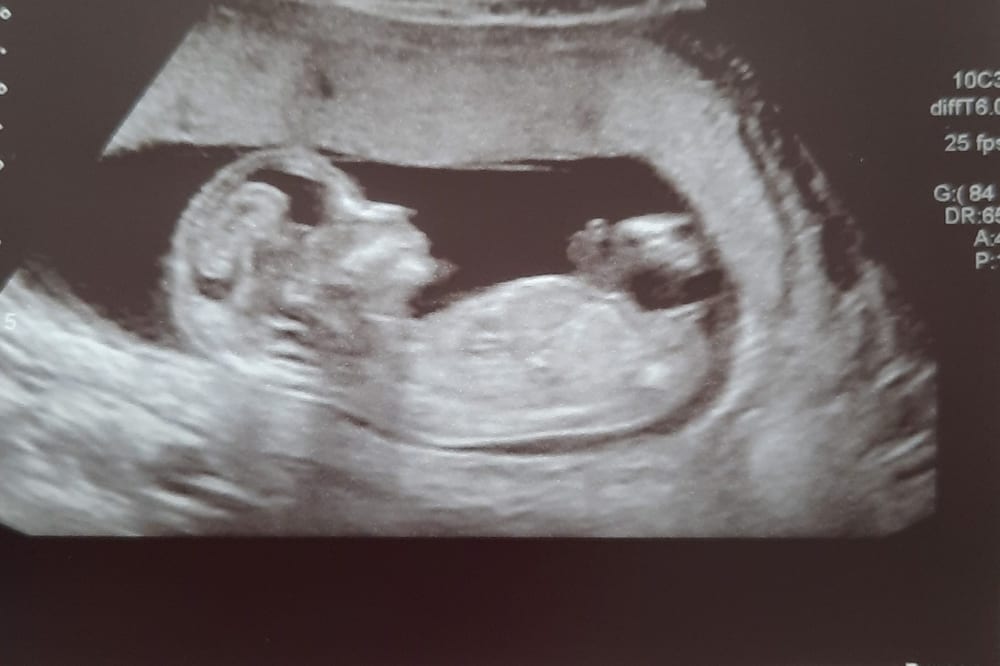
Life went on. Nora grew. We began to work together. My practice changed. I stopped working alone in the studio and started thinking about how to make sculpture with the people and things already around me. I made work with my daughter, with my Mum. I made sculptures with toddlers and their grown ups. I watched all the processes of living collide into messy objects. making became an “assemblage,” not limited to the artist in the studio, but spreading out from this point like ripples. Flowing through things, bodies, places. Artworks are not made in a social vacuum. They erupt from and continue to influence exchanges, rituals, relationships between all things, organic and inorganic (7). I am making art when I am specifically building an art object, and I bring with me the experiences, environments and sensations from my body, life and home. I am always making art. What happens when we consciously open up our making processes as assemblages? Welcome the tangles in. If the act of making extends before we enter the studio and after we leave it, then everything we see, touch, hear and think as artists influences what we make. Co-production was the only production.
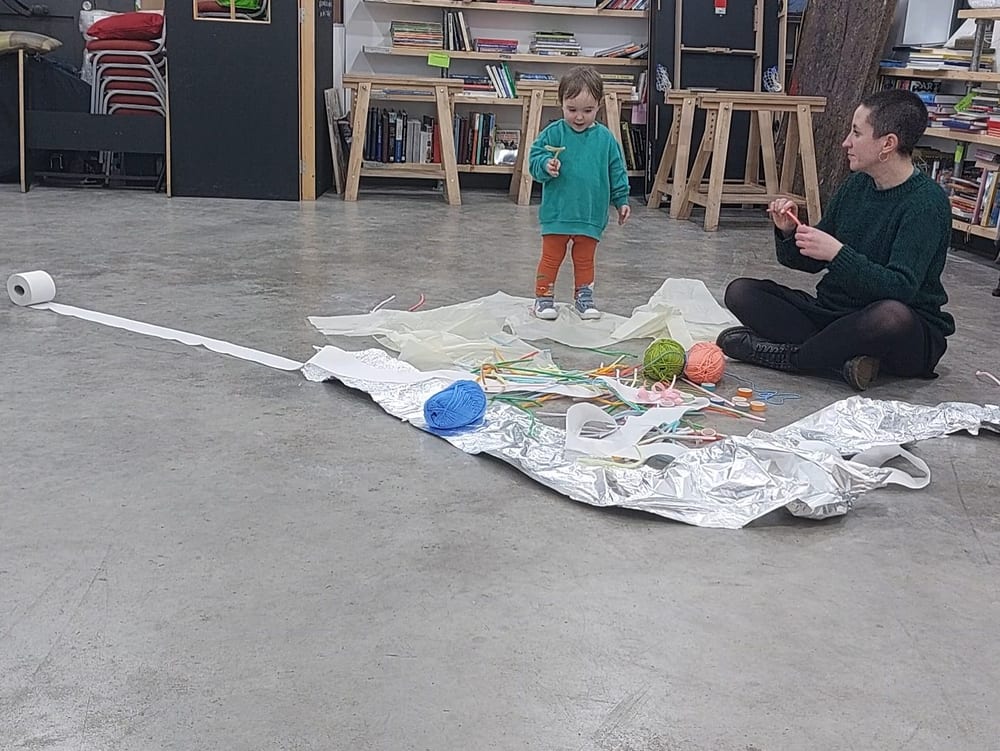
Motherhood was the first time I’ve been able to live in my body in celebration for the things it can do, not mourning the way it didn’t look. I forgot how to see the imperfections that millennials are trained to obsess over. Unlearned the damage. Learnt to use myself as thing for doing, not an object for viewing. Fuck stretch marks. Fuck mummy tummy. I saw my body as autonomously productive. Grew life from a cell. Made bones, guts, brain, muscle. Fed my baby as she doubled, tripled in weight. Took up space. She’s the hardest and best thing I’ve ever made. Will ever make.
Bodies are malleable. Changeable. Unpredictable. Philosopher Judith Butler tells us that they are fluid, flexible, changeable (8). Not fixed and finite. This idea creates vital space for trans and non-binary bodies, bodies which are differently abled or occupy an alternative space to societal norms. Our physical forms are not fixed ideals based on gender, ability, communication but can reach beyond this into other ways of living and being. Bodies change. Mine is now unproductive.
When I decided that I wanted a second baby, I learned that I am now infertile. Asherman’s syndrome. The operation which pulled placenta scraps out of me filled my uterus with scar tissue. My body is no longer a site of production. There is a blockage, a form, taking up space where there was a void which offered a habitable environment for a fetus. I made it unconsciously from parts of myself.
Presence where there used to be a space.
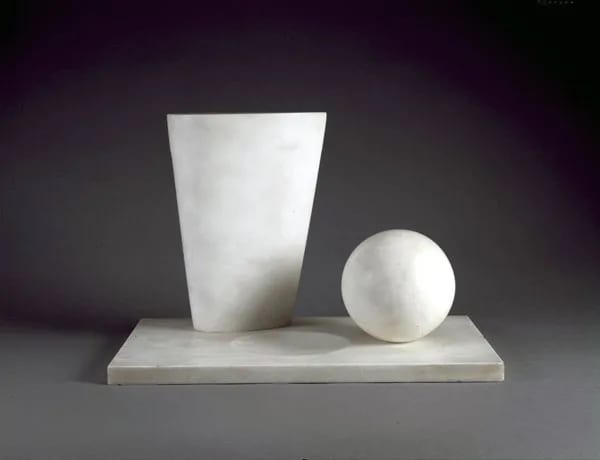
Barbara Hepworth used abstraction to find a new language for the female experience. In her works, gender wasn’t an essential collection of physical or biological traits, or the objectification of the body. Griselda Pollock notes that “Hepworth’s interest in relations between small and large begins to separate the typical iconography of such a relation, the mother and child, into two differentiated forms interlocking more abstractly in their intuited shaping as formulations of protectedness, vulnerability, difference, and dependence.” (9). A Butlerian reading. Small forms held by larger ones. Hepworth gives us new ways to talk about parenthood without reducing it to the objectified, gendered body.
After I learnt about my infertility, I went back into the studio. It’s been almost three years since I made sculpture without other hands, just my own. But I’m not alone this time. Making art in early parenthood led me to co-production and its critical importance, but the assemblage model has offered new permission to make objects alone again. My daughter is with me in the studio, even though her body isn’t. Her experiences of making now inform my own; literal gestures and transformations like tearing, squashing, stacking.
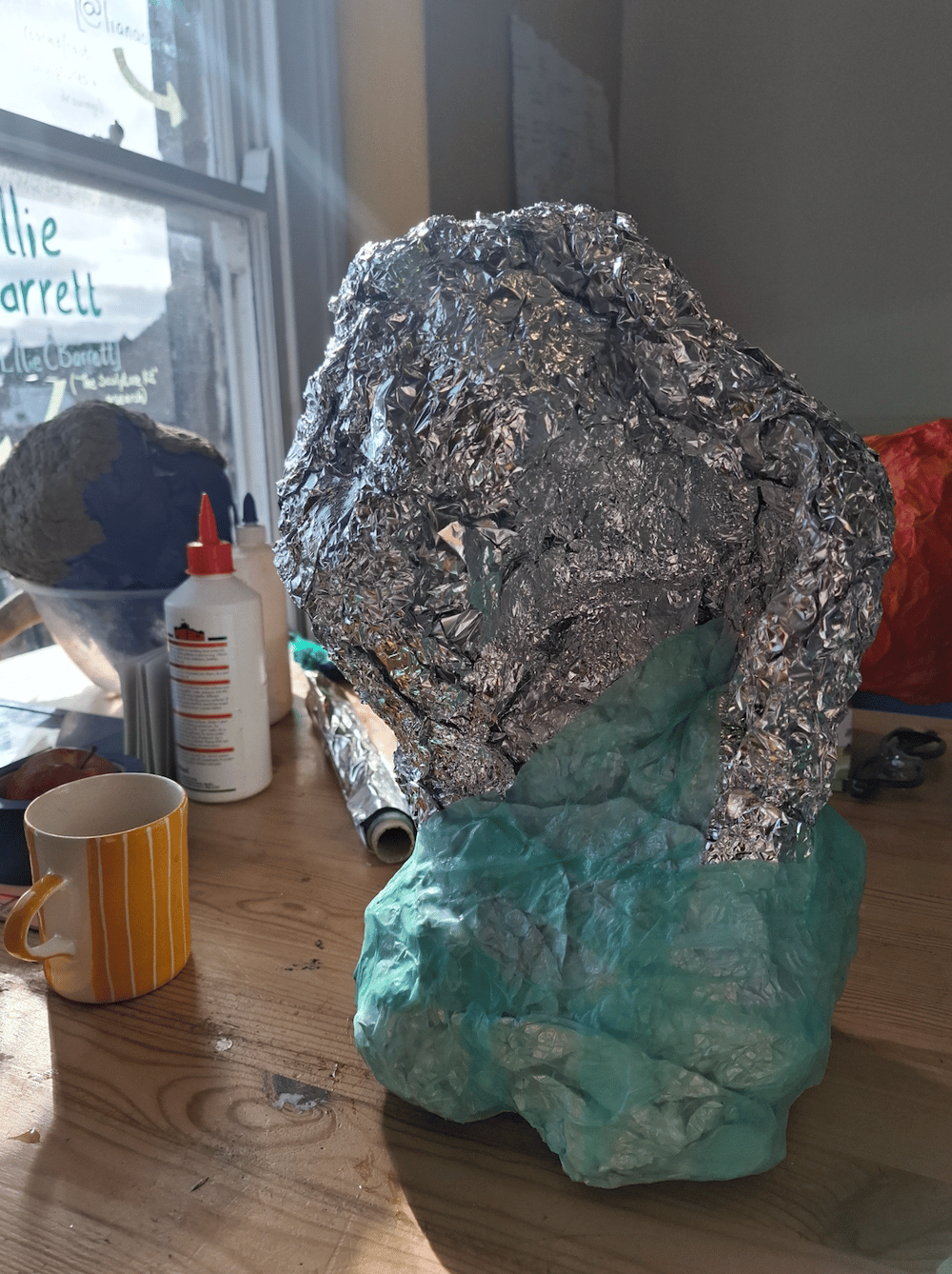
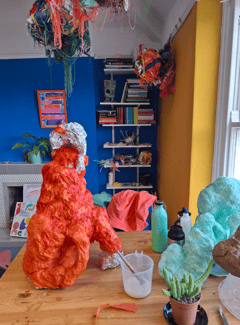
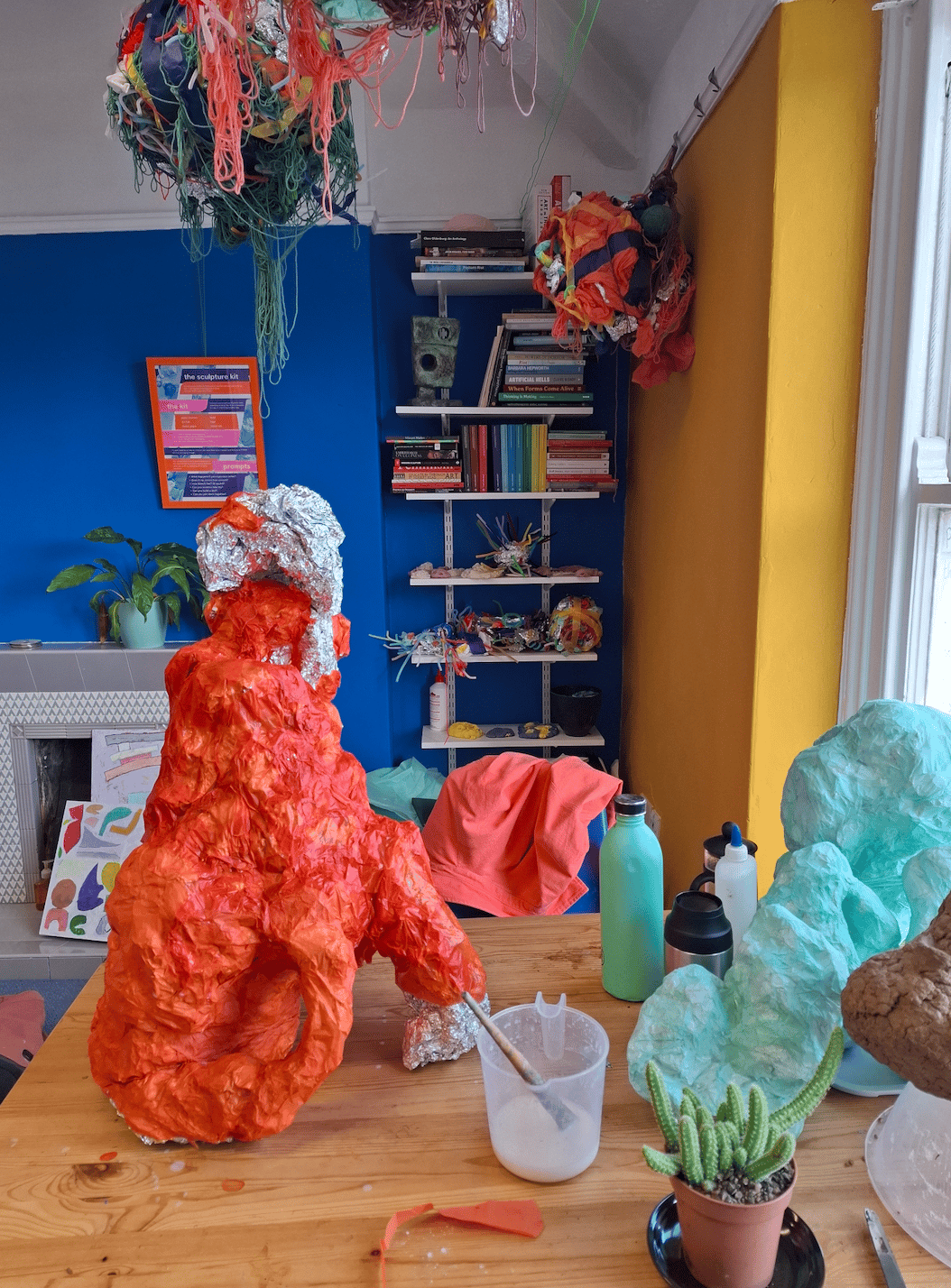
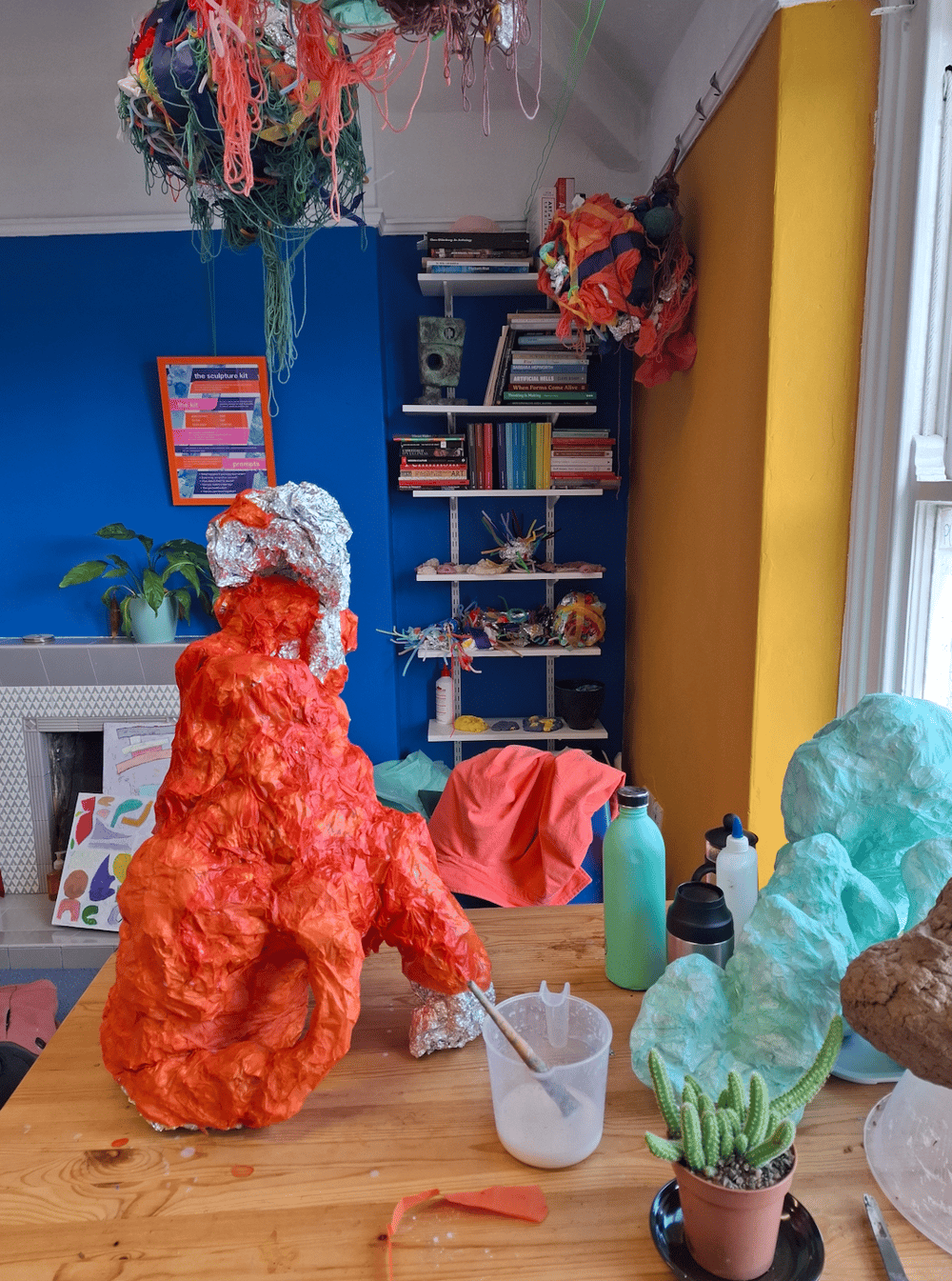
I squash tin foil into a ball, mould it around another. Another on top. And another. The form grows. It is malleable, changeable, unpredictable. Totters to one side, then the other. Unravelling, scrunching, building. I let it wobble. Adding structure, unconcerned with shape. A layer of tissue paper over the foil form applied with PVA glue adds colour, but also solidity and coherence. It forms a protective membrane. Shredding, soaking, sticking. Over and over and over. Compulsively. Flowing from me, not thinking. Sensuous rattle of foil, rustle of paper. Shaping. Forming. My body is the site of production again.
The Corinthian potter is credited with the invention of sculpture, but it is his daughter who grieved it into being. Traced the line on the wall which encircled her loss.
My foil and tissue sculptures look a little like rocks, but not quite. A little like vessels, but not quite. A little like bodies, but not quite. Glints of tin foil under matt tissue paper. Growths visible through outer skin. Bulky, unruly, hunched, precarious. In Hepworth’s legacy, they are about my body and of my body. I grow them like I grew my baby, like I grew my scar tissue. Their outlines encircle my loss.
Presence where there used to be a space.
- Lisa Saltzman, recounting the myth of Pliny the Elder in Making Memory Matter: Strategies of Remembrance in Contemporary Art, (Chicago & London: University of Chicago Press, 2006).
- Cara Jordan, “The Evolution of Social Sculpture in the United States: Joseph Beuys and the Work of Suzanne Lacy and Rick Lowe” in Public Art Dialogue, 3(2), 144-167 (2013).
- Griselda Pollock, lecture at “Talking Sculpture: Dialects of Making” symposium, York St. John University, 21 March 2024.
- Jane Bennett, Vibrant Matter: a political ecology of things (Durham: Duke University Press, 2010).
- Paula McCloskey, “The Non/Inhuman Within: Beyond the Biopolitical Intrauterine Imaginary,” in Studies in Gender and Sexuality, 22(3), 2021. DOI:10.1080/15240657.2021.1961494
- Kate Boyer, “Breastmilk as Agentic Matter and the Distributed Agencies of Infant Feeding” in Studies in the Maternal, 10(1), 2018.
- Alfred Gell, Art and Agency: an anthropological theory, Oxford: Clarendon Press, 1998.
- Judith Butler, Bodies that Matter: on the discursive limits of sex, (London: Routledge, 1993).
- Griselda Pollock, Woman in Art: Helen Rosenau’s ‘little book’ of 1944, (London: Yale University Press, 2023).