Material Uncertainty and Regulating Infinity
Lucienne O'Mara & Reece Jones
Material Uncertainty and Regulating Infinity by Lucienne O'Mara & Reece Jones
Published 30 June 2026
Lucienne O’Mara & Reece Jones in conversation for Mater. Lucienne’s studio, Herne Hill, London. May 2026
RJ: I was hoping to talk about our brains in relation to the medium of paint… I was going to suggest that you put paint down in a particular way because of your relationship with your brain…
LO’M: Absolutely.
RJ: And I have a particular relationship with paint because of my brain I think. I was going to lean into doubt and uncertainty, and expected you to be a voice for emphasis or actuality. But I was reading about you on my way here and a word which came up a lot about your work is uncertainty… so who knows where this conversation might lead. Can I ask the first question by inviting you to tell the story of what happened to you in 2017 and how you think that affects what you do? Do you mind talking about it in relation to your practice?
LO’M: I don’t mind talking about it at all because it’s become almost an experiment with myself and my entire current painting process came about whilst researching what was going on with me physically. I had a brain injury and amongst other things my eyesight was completely fucked immediately.
RJ: Is it worth illustrating what the injury actually was?
LO’M: Yes… but we’re still not 100% sure. I was in a minor car crash and thought very little of it, I had a bit of whiplash. Then I ran a marathon three weeks later, came into college [City & Guilds of London Art School, where Reece is a tutor and where Lucienne was on her MA at the time] and you thought I was hung over or something.
RJ: I remember.
LO’M: I actually couldn’t see properly. I was ok but things were a bit weird. But the next day I was at work, took a sip of coffee, keeled over, was rushed to A&E and essentially didn’t get out of bed for about two years. I was doing my MA, deferred and came back later part time.
RJ: You were physically incapacitated? You couldn’t see properly, you were bed bound, your balance was off?
LO’M: I couldn’t be in the same room as a moving plant because it would throw me completely. At this point we thought it was my eyes (which it wasn’t, it was my brain) as I had no sense of space. I couldn’t move my eyes up, down left or right, I couldn’t see much. It was so limited. I could focus on my hand if it was still before my face, but absolutely everything else was blurred out. I knew my periphery was there but I couldn’t see it.
RJ: So you had no spacial context? You couldn’t interact with the world around you?
LO’M: I couldn’t leave the house and walk down the road, because I couldn’t even make out where cars were.
RJ: Terrifying! And you’re an artist, so you’re thinking, not only is this physically awful but the thing which defines me is impossible.
LO’M: Yeah, but actually that was my way out of it. I was alone all day, making folders on my phone with images of stuff, because I was just trying to figure out the act of looking.
RJ: Images of what?
LO’M: Anything and everything. Loads of painting, and I was looking at things like shadows and light and things which were confusing to me.
RJ: Reminding yourself how to see the world.
LO’M: Yeah and once I started doing that I started looking at more specific things. I got really obsessed with Morandi.
RJ: Was it something to do with Morandi’s systematic observation? His repeated observation of things in a controlled environment?
LO’M: After a while. I was trying to understand my body in space and understand all the things around me. The way he paints his objects, there’ll be a really wobbly, very human line telling you that this is the side of something and another part of it will just be space, and you can read it as form.
RJ: Am I right in remembering that he painted directly onto objects in matt paint to neutralise their characteristics? Helping his eyes declutter, regulating the information so that he could get to the body of them, the form.
LO’M: Yes. He’s desperately trying to make sense of things. To go to such lengths to try to define what that thing is, to be such a recluse… Looking at those little formations and the shifts he made, those repetitions become so important and meaningful. I’ve thought about this for years. Those little bottles or containers have so little to do with specifics or description. When you’re working out stuff and you’re using paint to do it… what your objects are (specifically) is up for debate. As far as I’m concerned that’s what these forms are in my own paintings, they’re objects in space.
RJ: You mean you wouldn’t want them to have their own particular, distracting story or behaviour? You need an object to be pared down somehow?
LO’M: It’s enough that it’s an object… a thing in space. I wanted to lock in.
RJ: At this point in your recovery are you doing any making? Do you have a pencil in your hand or anything?
LO’M: No.
RJ: I think it’s amazing that you used thinking about the act of painting to drag yourself back into the world.
LO’M It was a way of not being upset about it. I looked at it like a type of research project. I found it interesting. Taking in visual information, your eyes are a part of it, but your brain is a bigger part of it.
RJ: Did you discover what was happening?
LO’M: An area of my brain at the top of my neck switched off and stopped working. A doctor described it like a laptop which is switched on but has crashed. I had to retrain my brain. Physio was as simple as looking at my extended fingers or walking backwards. Watching videos of travelling down an isle in a supermarket.
RJ: You were literally watching films to re-coordinate you with space?
LO’M: Very slowly teaching my brain that it can do things. A tiny bit at a time and I still have to do it every day. But now I can do it in an actual supermarket.
RJ: And now you can walk and drive and stuff. Can you run?
LO’M: No. It’s a bad idea.
RJ: You don’t define yourself this way and it’s not how your paintings are defined. They’re not paintings about neurological injury at all. But the reason that I asked you about it up front is because your methodology routes back to this time in your life, you wouldn’t be making paintings like this if not for that event. You were always a very physical painter and you were making work which was very materially led.
LO’M: I couldn’t define the earlier work though. Weirdly, this gave me focus.
RJ: Statements about your work declare this incident as affecting the way you see and therefore the way you make work. It seems to indicate a reduction in priorities of sorts. Are you an abstract expressionist?
LO’M: No. I don’t look at myself as abstract at all. These are still life.
RJ: That’s provocative though? These are not literally representative of things? They don’t tell the story of an object… Are they proxies for objects or avatars for the idea of an object?
LO’M: Yeah maybe. It’s more the idea of an object. They’re placeholders to talk about something. I generally just get cross with the terminology because it doesn’t work… it’s not nuanced enough.
RJ: So the problem with the word abstract is that it lacks the idea that you are trying to place something in space literally?
LO’M: There’s no object at all in abstract expressionism. There’s action and playing with space through mark making but there’s no object and the space is one which you are making just through painting. It’s less about trying to define something in space. It’s tricky.
RJ: What I really like about this is that we’re struggling to define what you are doing. One of the things that I’m really interested in in your work is that it feels definite when we first encounter it, we think we’re dealing with something definitive, something extremely confident and certain and the knowledge that paint put down in a certain way will result in certain relationships emerging. It has something to do with knowledge and colour theory. Material understanding of viscosity and opacity and flow. We look at your paintings and we say “she absolutely knows that if you put that down there, it will affect that bit”. What we arrive at is a series of complex relationships, spacial, chromatic relationships and those elements are presented through gesture and application. I think that when we break it down like that, that’s abstract expressionism. But… what I’m learning is that that’s not what’s happening?
LO’M: No, because one of the main things that got me to this point is that as soon as you put some paint on a flat surface, you have just revealed all of your uncertainties in terms of seeing. You instantly believe depth on a flat surface. It’s showing you that everything is uncertain.
RJ: Like The Matrix!? So you’re saying, if I can make this flat surface behave like space, then everything including space is uncertain?
LO’M: Yeah.
RJ: Which may have been more mind blowing in C15th Italy, at the advent of perspectival drawing. But it’s one of the things we need painting for… it insists on some of those fundamentals being considered and constantly re-considered, which is something that we take for granted. It’s something we don’t do, until we are artists or we get a bump on the head, or in your case, both.
LO’M: I never thought before about why I see things the way I do, because you just do and if you thought about it too much you’d go nuts. But then I had to see things and decipher them; “that’s a shadow, which means that’s form and that’s space”, so when you start painting, those things are under much more scrutiny. I needed to be able to define things differently. To separate and understand things. The reality is that certainties are there because we need them, but nothing is that clear or physically that absolute.
RJ: Is that one of the things that art is useful for? It helps us stay in the realm of the uncertain and accept how interesting that can be instead of simply going from A-B and knowing everything that we need to know about that.
LO’M: Yeah. The most abstract and thought provoking paintings I find are Lucian Freud or something…
RJ: The close up of the dress in Las Meninas or El Greco’s rocks?
LO’M: When something was only real like that for that second, but you’re looking at it like this for these reasons… there are so many different ways in which that is not real.
RJ: This is really changing the relationship I have with your paintings. I live with one of them. I see light bounce off it or be absorbed by it, it changes all day. I thought I found it continuously engaging because it’s masterful, confident and complicated, but I’m learning that the reason I’m not bored with it is because it doesn’t know what it is yet, and it never will.
LO’M: No it won’t.
RJ: It’s built out of a search for things as opposed to an existing knowledge. We need to be careful not to undermine the things we’ve learned and what we know, but that’s really interesting because I thought our conversation today was going to be about how paint for me is all about not knowing and for you is all about knowing, but it’s also about uncertainty.
LO’M: But that’s what I know. It is a thing to know.
RJ: That’s right. Which is why I wanted to talk about how we manage unknowing. I even brought a chapter from Rebecca Fortnum’s On Not Knowing, which is something you’ve read I think? This chapter focuses on how artists leave space for unknowing. The studio as a constant laboratory, a site for development even. She discusses Bruce Nauman’s film of his studio when he is not there and how the studio is the star of the conversation. The fact that the art is being made or defined by the studio regardless of whether he is present.
LO’M: I think that’s why, for me, working within a simplified structure allows me to be ok with not knowing.
RJ: Regulating the format?
LO’M: There has to be a structure for me to be free. There’s so many decisions and elements, there needs to be something regulating that for me to be comfortable enough to not know everything else.
RJ: So in your practice in relation to materials and how they sit on a surface, what are the elements you can say you know?
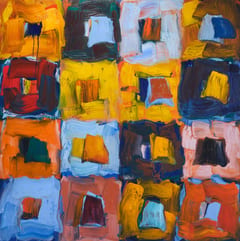
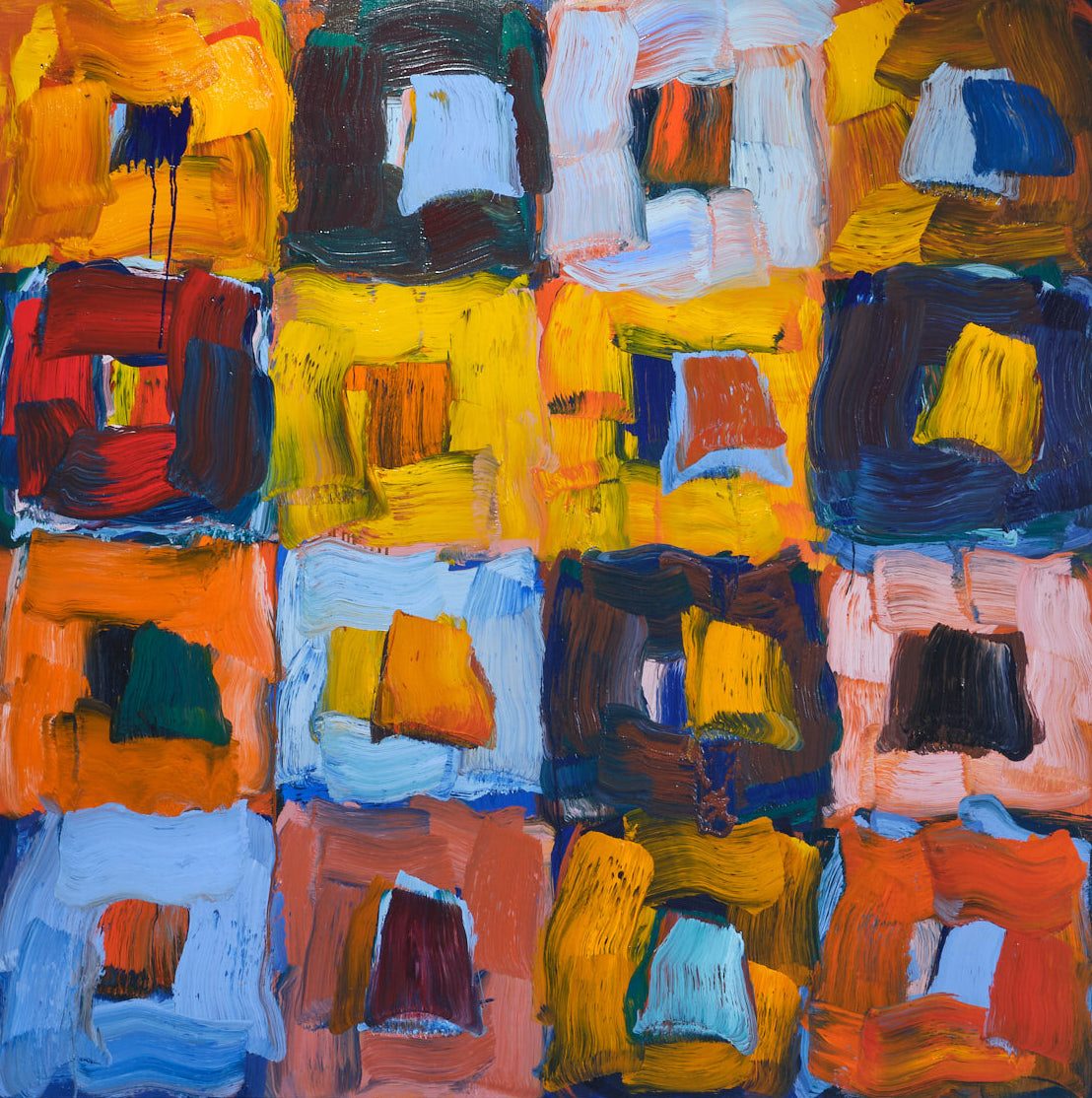
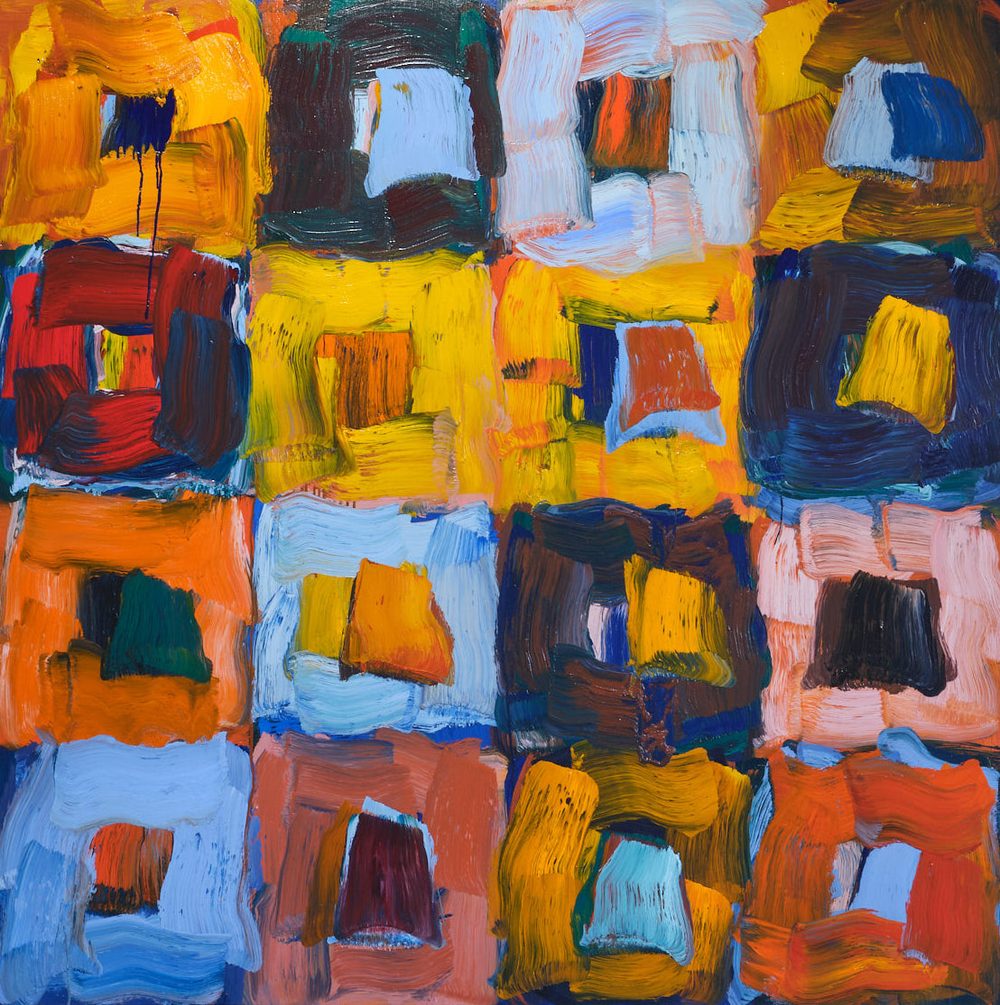
LO’M: I have a pre decided grid. I divide the canvas into sections which all have their ‘object’.
RJ: So you set the pitch out for the game to play on?
LO’M: And then I use the same size brushes on each painting. Just one size per individual painting. I use multiple palettes.
RJ: I think it’s important to hear about the things which regulate the outcome. All these little systems are more or less set. So then the uncertain elements are…?
LO’M: I always start off with an idea of what I want the painting to be and do the first layer of colour, but then there’s thousands of choices.
RJ: and things unseen right? So each big brush mark adapts a previous application.
LOM: They are only as they are now because they interact with everything previously. So these colours are defined by their predecessors.
RJ: I like the way that the brush marks poison one another.
LO’M: They’re in their defined spaces, but they’re all the same stuff, so they’re mixing with and affecting one another. That’s what is not defined.
RJ: From the ground to the finish there’s a total atomic exchange…The final palette, the final colour is dictated by a kind of compromise.
LO’M: It’s all relationships.
RJ: So you don’t really know what the final palette will be.
LO’M: No. I’m desperate to be able to pre-mix colours and have them be ready, but it’s not happening. I don’t know what the painting is going to need at a particular point.
RJ: So what dictates the decision making? Do you basically stand back and say “ok well there’s a particular type of petrol blue here and if I put an orange on that it will do something cool to the thing that’s happening next to it”?
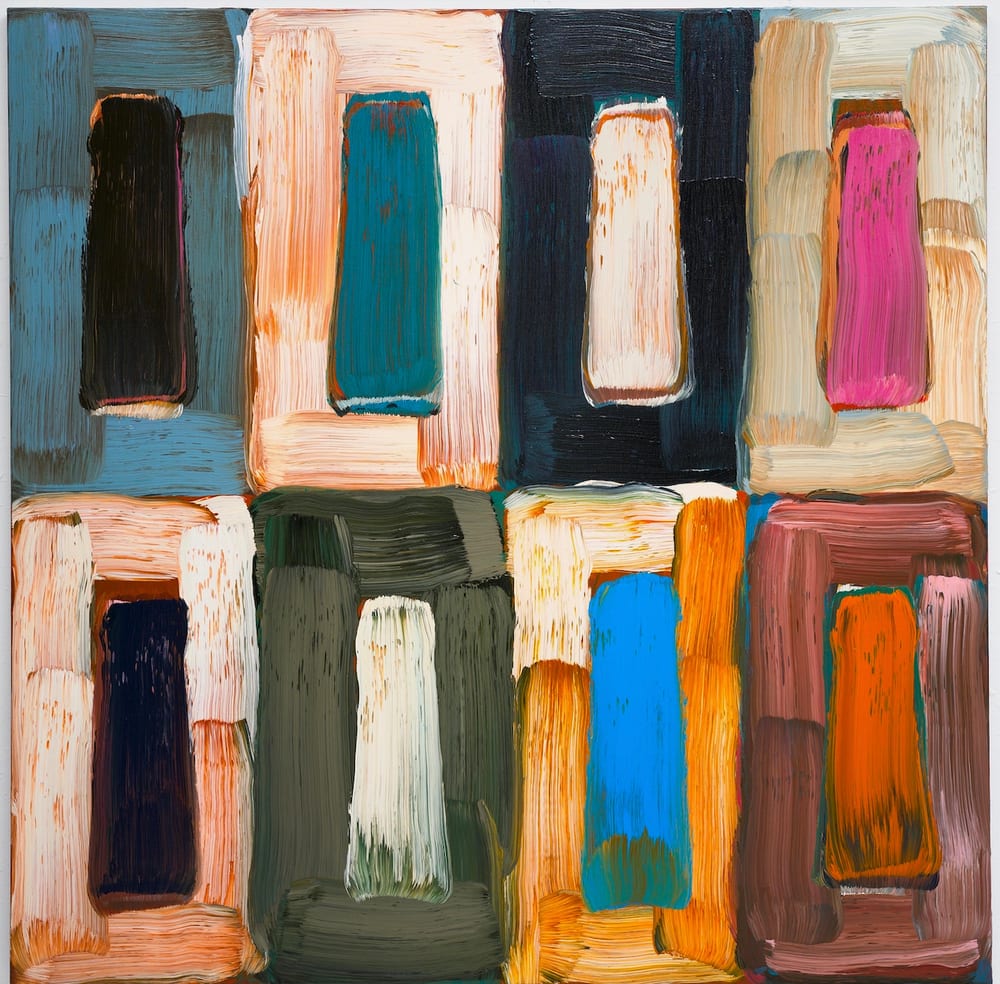
LO’M: Yes, but one thing that’s good about having to work fast to maintain wet on wet is that I can’t take long second guessing. Plus working in layers, essentially it means that nothing is the wrong thing really…
RJ: That can’t be true! You must put things down and hate it?
LO’M: Yeah that’s not completely true, but it’s good to have that horrible moment in there and ultimately you don’t know what that’s going to do six steps later. And sometimes the little thing that doesn’t fit, that pokes out of the painting, that’s the best bit.
RJ: Right, so you’re constantly looking for relationships which will help out. That painting above your head, there’s a bit of orange and a bit of purple having a chat. If they were on their own that wouldn’t be a fun thing to look at, but because they’re there with that weird skin tone colour and another blue and because the orange is replicated elsewhere, we can deal with it, it’s a juicy thing to encounter. It’s all formal relationships.
LO’M: Yes, and of course there are paintings where it just goes awry and I scrape it all off.
RJ: So Paintings do die?
LO’M: Yeah there’s slop buckets everywhere.
RJ: What’s the ratio of failure?
LO’M: One success in six…!
RJ: That seems important, because once we get to exhibition and we encounter them, those are the survivors, they made it.
LO’M: I wish I could plan more.
RJ: But wouldn’t that defeat the object? It’s interesting that materially, these things which incorporate chaos and an atomic exchange, when they’re on a white wall in a brightly lit space with a nice window, it’s the final act in the making. It’s the part where the vitality, the plasticity, flow and chaos of materials is signed off and we can see it for what it is. I think the exhibition of things is a really important part of the process because it’s the bit where it gets locked in. You can’t go back (unless you’re Turner at Varnishing Day or something). It’s been consigned to looking at.
LO’M: So when do you have to stop? Is it decided for you by something?
RJ: It used to be. I used to make charcoal drawings and the methodology was locked in. I had a process of making drawings carefully, which were “realistic”, pictorially representative to a high level, sanding them off, creating a new vibration in the surface, a new noise, then redrawing them again and again. It kind of became holographic and eventually you’ve done it enough times that the idea of gesture, the artist’s hand and the material evidence of charcoal was minimised and there’s a sense of it being more mechanical and therefore more “believable”. Even as I’m saying that I’m more aware of why I stopped doing things that way. I have a problem with virtuosity, I have a problem with certainty and a problem with a process so defined that I know what I’m going to get before I embark on it. I have a problem with the illusion of reality being the headline of the conversation in relation to the making of and the looking at a piece of artwork.
LO’M: Why?
RJ: Because it’s a bit boring. I don’t think that’s all the work was doing, but I found myself having those conversations far too often. It felt like a magic trick and I’m not interested in magic tricks.
LO’M: It must have been hard to leave such a strict structure?
RJ: It has been. Where I end up is materially using the stuff you use. I wasn’t using paint much before, I wasn’t a painter with a capital P. I’ve always painted in relation to the drawings and I teach fine art and talk about painting all the time, but it wasn’t my methodology. So I dropped all this certainty and found myself in a scary space, where I wasn’t in charge. It’s taken me three or four years to get to the place you were discussing before, where the act of not knowing can be engaged with proactively. Interestingly some of the processes which help me to do that relate to the old drawings. So I’ll take the canvas off the stretcher occasionally, staple it to a wall and sand it back, or there’s some other corrosive act which wipes the surface or destroys the integrity of it and gives me something to respond to. But there’s so many more variables now. There’s so many more ways of having that yes and no conversation with the work. I think that the truth of paint as a material is that it already contains uncertainty as part of its make up.
LO’M: But you’re more interested in the inevitability of the unknowing.
RJ: The knowledge that I will never again make an art object knowing what it will look like as I begin it.
LO’M: A question you always used to ask, which I really like was “what’s the jeopardy? How do you know when it’s wrong”? Maybe in your head you were thinking “where’s my own jeopardy”?
RJ: Yeah, although I’m really good at ignoring my own advice or questions.
LO’M: So, is there something which draws a painting to an end?
RJ: I don’t think I know yet. Sometimes you just know that if you do anything else to something it’ll die right? I haven’t mastered that though. I borrow a studio space currently from Jonathan Wateridge, who is a very close friend. I think he is one of those people for whom the act of artistic intervention is challenging but exciting. He will risk the death of a painting in a heroic way and it will die or something else will happen and it’ll be rewarding and he’s very good at that. I don’t think I’m one of those artists. I need something else to run interference (like process). In my case now it’s just that the processes are multiple and there’s more options. Which is more open, but makes it much harder to know when something’s finished. Because I’m a fan of painting, when I first started painting I was confronted with this material which I was enjoying and there were a thousand different ways in which I could do something. It’s taken me until now to realise that there are certain things which I do with some regularity, which have found their way into my practice.
.jpeg)
LO’M: That’s the thing. When you’re an artist, just the materials can be a red herring. I had years of my life collecting scrap chunks of wood because I was going to make paintings on them.
RJ: But didn’t that inform what you’re doing now?
LO’M: It did. It wasn’t a waste of time. But it could have evolved quicker. I eventually just wanted the paint to be the wood. When you’re discovering new materials you have to have some boundaries with yourself otherwise it’s endless. But to get to the point of ultimate commitment is terrifying!
RJ: I think I’m a frustrated formal abstract expressionist. I think (in an ideal world) I’d like to get to where I want to be without figuration or image.
LO’M: Really?! I don’t think so. That’s so not true.
RJ: Yeah, everyone who knows my work says that’s bollocks. But I’m jealous of abstract artists.
LO’M: I’m jealous of figurative artists.
RJ: Here we go!
LO’M: I would give anything (and I try all the time). Once a month I try.
RJ: But the role of representation in my work is that I want it to act as a kind of stadium announcer for the thing. To usher something in. I think it’s a lot to do with my own mental health. It’s not about mental health but it’s borne out of a state of mind (or states of mind). Not unusually I’m shitting myself about everything and that affects my decision making. It affects my relationship with masculinity and politics… There’s obviously nothing unusual about that, but I think my paintings are a product of it. I want them to deal not just with uncertainty in terms of material or formal knowledge or outcome, but with global uncertainty. I like the idea that they aren’t declamatory. Some people’s work really seems to know what it is and what it wants. I like the idea that it doesn’t and that there’s loads of room for us to understand that. That not knowing is key. It leaves it vulnerable, which is why I sometimes use images of things which are apparently iconic and confident.
LO’M: And masculine.
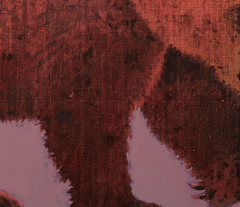
RJ: Things that can hurt you. But I’d like to think that in the making of them they lose their certainty. Almost to the point that I struggle to say “that’s my painting of a bear”.
LO’M: And the fact that there’s already stories which have been made about these things and that’s why we see them this way.
RJ: Yes exactly. We don’t actually know about the thing, we know what we know about the thing.
LO’M: We’re already one removed.
RJ: It’s how the world works. The facade of confidence and certainty is quite dangerous presently. I never want to make art which behaves like that, so the materials have to fail and fluctuate and shiver.
LO’M: But within that you need something which presents as certain. Because you’re presenting it in the way that you do, you are evidencing the falsehoods in it. It’s certain in itself, but the thing it’s representing isn’t certain.
RJ: Yeah I like that. There are so many ways to do that aren’t there? It could be tonal, like an Ad Reinhardt, where the tonal proximities are so close as to make definition improbable. Or it could be that you corrode it, do things to it in the making which ask it to back off and it tries to invite itself back in and you have to back it off again. The thing you end up with isn’t the thing anymore, like The Ship of Theseus or Trigger’s Broom in Only Fools and Horses. It’s still a broom, but it isn’t the same broom anymore, it’s been rebuilt so many times.
LO’M: I like the way repetition works here. You can present the same truth again and again, it causes differences, which underlines that there’s not real truth at all. It’s shifting perspectives. That’s how we receive any kind of truth, like news, many people describing and reacting to the exact same thing completely differently. The certainty is in the telling of it.
RJ: Yes and I like the way materials can join that conversation. I like the idea that we’ve all got a relationship with conspiracies for example. We all sit somewhere on the spectrum. And as the world shifts we find certain things out and we have to shift our relationship with certain stories or positions. I find that seismic problem interesting in relation to the process of making images, which is possibly pretentious but it makes sense to me.
LO’M: I don’t think it’s pretentious, I think it’s how we process things. Truth and certainty and how it fluctuates is how painting is potentially political. Any painting can be read in a political way because ultimately you’re arguing in some form about truth, certainty, relationships and story telling.
RJ: We began with the debate around the definition of your practice and whether you are abstract. What we’ve arrived at is that we are both interested in the way in which things fluctuate in and out of actuality.
LO’M: I would accept the fact that I was an abstract painter if that’s what everyone else is. It’s funny because the way Alex Katz talks about his work is so different to the way I see it. He says he paints just what he sees. But he was a teenager in a period where everything was advertising and Hollywood and story telling with goodies and baddies and objects. Certainties. So I think we would read his work in a way that he wouldn’t be able to see it.
RJ: We’re children of a post modern conversation. We can enjoy the complexities of uncertainty and failure and doubt. We can also indulge in debating abstraction because it’s not life and death. Like Guston said, when he emerged from Woodstock and everyone freaked out because he wasn’t an abstract expressionist anymore “we’re not all on the same hockey team”. Like ‘chill out man’! It’s hard to imagine it being that important. The idea that he was somehow letting something down.
LO’M: But I’m jealous of how there was clarity to those changes and definitions. They were a huge deal. But now those definitive timelines don’t exist.
RJ: But are we in a new era?
LO’M: What’s that?
RJ: I think the thing you and I are obsessed about will become a bit more important (assuming the world doesn’t implode). Being someone at the moment who smears stuff on stuff and who uses that to create space and time for thought and who enjoys the way in which that deals with knowledge and uncertainty and who thinks about it metaphorically and in terms of time… at the moment that feels like an increasingly radical thing to do. Perhaps we are in a period where making space and time for material execution is a rare and rebellious thing to do.
LO’M: Because of AI.
RJ: At least because of AI! But also because of information in general.
LO’M: Speed…
RJ: Of course there’s a danger that it’s seen as being an elite activity and not available to everybody, but the truth of doing it in a chilly railway arch in South London and getting it all over yourself and breathing it in… I would argue that it’s a more radical act now than it was thirty years ago.
LO’M: Really!?
RJ: Thirty years ago it was seen as being stupid. It wasn’t representative of anything and conceptual artists moved it out of the way. But I think that the act of painting is a conceptual act.
LO’M: Of course it is. It’s nice to have a hopeful thought about our current era.
RJ: I think going to work and making the time to make art is harder than it has been for a while. Time and money are scarce and it often seems like a silly thing to do.
LO’M: Yeah, is it self indulgent…?
RJ: A reality check… but as you have been saying there isn’t a reality to check against.
LO’M: And the reality we are forming is probably because of Instagram or something. So presenting yourself online in certain ways, is that feeling more real than reality? More real than fucking around in a studio?
RJ: It’s nice - that in order to have this conversation today you had to wipe the chair down because otherwise…
LO’M: …you’d get my reality on your arse!
RJ: Yes!
LO’M: Even though we’ve just been describing how aware we are that nothing in a painting is a fact, the fact that you’re doing it, you’re covered in it, you can see it and smell it, that’s a fact.
RJ: If we’ve concluded anything about these materials it’s that they are atomically unavailable for definition and as a result we can have a very real play with uncertainty.
Reece Jones is an artist who lives and works in Suffolk, UK. He is a lecturer in Fine Art at City & Guilds of London Art School and Associate Lecturer in Fine Art at Anglia Ruskin University. He is a residency selector and mentor for Good Eye Projects and is a regular visiting artist at the PLOP Residency. An advocate for the importance of discourse in the studio, Reece runs bespoke critical feedback and close viewing sessions for artists.
Lucienne O’Mara (br. 1989), lives and works in London, UK) studied at City & Guilds of London Art School, London, UK. O’Mara has had solo exhibitions at Nino Mier Gallery, New York, NY, US; Gillian Jason Gallery, London, UK; Flowers Gallery, London, UK and OHSH Projects, London, UK. Recent group exhibitions were held at Flowers Gallery, London, UK; Xxijra Hii Gallery, London, UK; Haricot Gallery, London, UK and Somers Gallery, London, UK. She has been the recipient of the Painter Stainer’s Prize, the Tony Carter Award, and a finalist of the Ingram Prize.