Malachite and the Origins of Copper
Victoria King
Malachite and the Origins of Copper by Victoria King
Published 30 June 2026
From the Bronze Age to the Information Age, metals have shaped civilization. This article investigates smelting: how copper is formed from the mineral malachite, looking at its historical significance in Britain and why the current use of copper is changing. This isn’t a complete history of metallurgy or a guide for smelting; it’s a journey of discovery that hopefully sparks inspiration.
Malachite Ring – Materials that tether us to ancient rites
In economically developed nations like the UK, we benefit hugely from the conveniences that modern manufacturing brings. Sophisticated means of mass production and increasingly global supply chains mean that we have greater access to the industrially produced goods that we desire at a rate that is both faster and cheaper than ever before. At the same time, however, this convenience has created a growing sense of detachment from the origins of the materials and objects we use every day.
As a jeweller, I see these patterns of disconnection mirrored in my own field. I can easily order a precisely specified piece of copper without needing to know anything about how it was formed, what processes it went through, or where the raw material came from.
The technical precision of the materials I work with is incredibly useful, but it also means that much of the story behind the metal, its geological origins, the environmental cost of extraction, the labour involved in refining it, is rendered invisible.
In this context, I think it’s important to reflect on how materials are sourced and understood, not only in terms of their function or aesthetic value, but also in terms of their histories, origins, and impacts. Understanding where something comes from, and how it is made, fosters a deeper awareness of the systems that support our lives. As a maker, I see this as part of my responsibility, to remain curious about my materials, to ask questions about their origins, and to stay connected to the physical world even as technology mediates more of our experience.
My interest in smelting began through conversations where I work at Central Saint Martin’s, an art and design college in London, part of the University of the Arts London (UAL). I work as a Technician in ‘3D Make’ across nine different workshops, helping students with woodwork, metalwork and digital fabrication. My focus is metalwork as I studied ‘Silversmithing and Metalwork’. I’ve had many inspiring conversations with Vince Hart, the Paint and Surface Specialist Technician. His focus is on pigments and, because metals and pigments often share the same mineral origins, we spent a lot of time discussing their overlap. This connection becomes even more interesting when considering the theory proposed by R. F. Tylecote in The Prehistory of Metallurgy in the British Isles, where he suggests that metals may have first been discovered by people working with minerals for pigments.
“… that copper was first accidentally smelted in a pottery kiln. Possibly a copper ore has been used as a pigment and the conditions were so reducing that the pigment was converted to metallic copper and ran down the pot.”
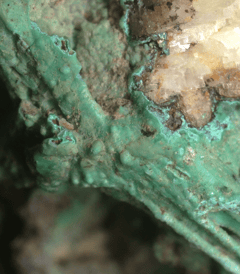
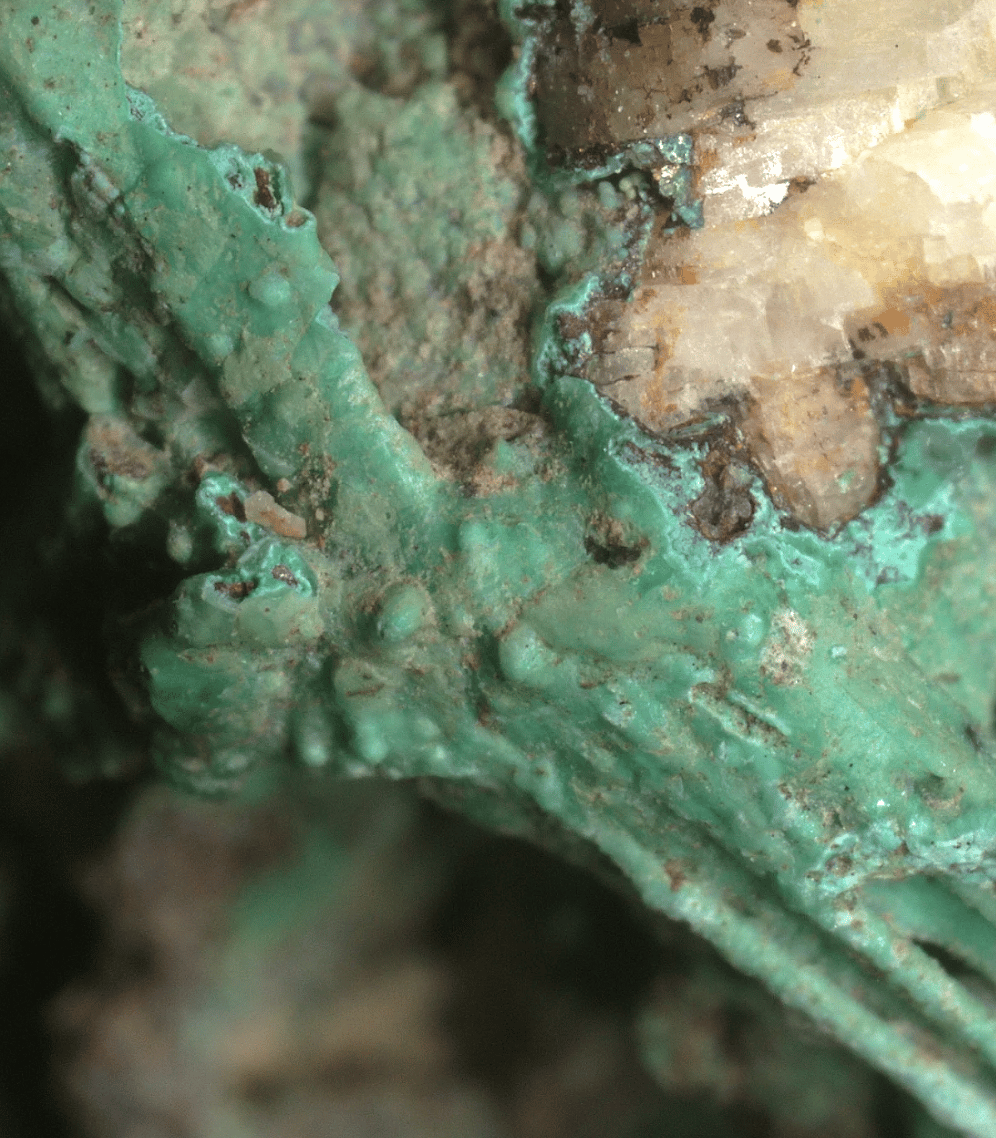
Malachite found at The Great Orme, Wales. This photograph was taken on a microscope at the Central Saint Martin’s Biolab. From the bright green colour, you can see why people were first drawn to this mineral for use in painting.
I find it fascinating that metalwork, ceramics, and painting are historically intertwined in this way, and that I now work closely alongside specialists in all three areas. Knowing this history makes the disciplines feel less separate and the materials more connected. Wanting to develop a deeper knowledge of metals, it felt natural to start at the beginning. With the aim of learning how to smelt metal, I reached out to The Society of Model Experimental Engineers. Through them, I was put in contact with Salim Patel, who had previously given a lecture on smelting and bronze casting. Salim was incredibly generous with his knowledge and invited me to his workshop in Havant, where I spent the day with him and his friend Jim smelting copper and bronze casting.
What stood out most in this experience was how easy the process was. Hopefully that doesn’t sound arrogant! I thought we would need a lot more equipment, but we were doing it in a way that’s pretty similar to how it would have been done in the bronze age, except with a modern-day gas furnace. It made the transformation from mineral to metal feel immediate and tangible.
Here is the step-by-step process:
- The malachite is crushed into a fine powder using a pestle and mortar.
- Charcoal is also crushed into a fine powder.
- These are then put into a crucible in fine layers.
- The crucible is then placed into a furnace and heated to around 1100 – 1200.°C for half an hour.
- Then ta –da! Metal is formed!
A piece of the mineral malachite and a piece of copper that I have smelted.
The most important part of the process is the reduction reaction. Charcoal is used to produce carbon monoxide which removes oxygen and any impurities, leaving pure metal behind. Understanding this process was incredibly inspiring and freeing. I hadn’t discovered anything new, I had discovered something foundational, so incredibly linked to human existence. Somethings can only truly be understood by doing them.
Powdered malachite and charcoal being added to the crucible layer by layer.
The furnace in action, and the glowing piece of copper inside the crucible.
Salim and Jim had originally met while working at Butser Ancient Farm, which became another important point of reference for me. Through conversations with them, I learned about the Great Orme in North Wales, the oldest known Bronze Age copper mine in Britain, dating back around 4,000 years. I decided I would have to go to the mines to learn more. So before going to North Wales I bought a piece of malachite from the Great Orme from a collector. I decided I would take this piece of malachite on a pilgrimage back to the mines where it was originally formed.
Pilgrimage taking the piece of malachite back to the Great Orme Mines
Visiting the Great Orme marked a turning point in my research. It transformed something abstract into something physical. Over five miles of prehistoric tunnels have been discovered underground in Llandudno, North Wales. A vast and intricate labyrinth, more organic than engineered. When I first descended into the Great Orme Mines, I realised how much my expectations had been shaped by popular culture. In my mind, a mine was something out of Indiana Jones, with rail tracks and wooden supports. But the reality was something very different and much more fascinating. The tunnels felt alive. They twist and turn through the limestone like root systems or underground rivers. The floors rise and fall unpredictably, and narrow corridors suddenly give way to wide chambers with jagged, fractured walls. There are no straight lines, no grand design, only the logic of the malachite veins, which dictated where the Bronze Age miners would dig. They weren’t carving out space for convenience; they were following the green malachite, wherever it led.
Being in that environment created a tangible connection to the past. It felt like piecing together a vast historical puzzle, where the relationship between material, process, and human effort becomes much clearer when experienced first-hand. I decided to make a piece of jewellery from the mineral I had carried with me for so long. I chose to make a ring, as rings have always symbolised connection. Just as a wedding ring or signet ring signifies a bond with someone, this ring would serve as a symbol of my connection to the past.
To create this piece, I decided to learn the art of lapidary, the craft of cutting, shaping, and polishing precious and semi-precious stones. I discovered the Sidcup Lapidary and Mineral Society online. After attending a meeting, I was inspired to become a member. For this ring, I first used a diamond core drill to create the hole, then a trim saw to remove the excess material and form a rough shape. Finally, I refined the piece with a combination of grinding and sanding wheels, smoothing the edges to achieve the finished result.
The ring on display at The Lethaby Gallery, Kings Cross
Things have moved along quite a bit since the Bronze Age. Today demand for copper continues to rise, driven in part by the expansion of digital infrastructure, including data centres and artificial intelligence systems. To better understand this contemporary context, I visited a large-scale distribution centre in Dartford. The level of automation was striking. Systems powered by artificial intelligence coordinate the movement of goods, using robotics, real-time data analysis, and predictive models to optimise efficiency. Processes that once relied on human judgment are now handled by complex, largely invisible systems.
Robots moving products around in the Amazon warehouse
While these technologies can feel distant from traditional craft practices, they remain deeply dependent on the same materials. Copper, in particular, is essential to this infrastructure, used extensively in wiring, servers, and communication systems. Despite the apparent immateriality of digital life, it is still grounded in physical resources extracted from the Earth.
This raises important questions about awareness and responsibility. As we continue to develop and rely on advanced technologies, how do we remain conscious of the material and environmental implications that support them? Is it possible to engage with these systems critically, while still embracing their creative potential?
In my own practice, I’ve begun collecting copper from electronic waste as a way of exploring these questions more directly. By reclaiming and reworking this material, I’m trying to better understand the quantity of resources required to produce even a small object, such as a ring. In the next part of the project, I will be expanding on the research I have already started. I look forward to sharing this once it’s finished.